





Have You Exploited Proximity in Your Classroom?
At this point in the year, most of us are acquiring sore muscles from moving furniture around and deciding how to arrange our desks. While moving your furniture, have you considered your traffic flow? Can you easily see each student’s desk when you walk in a complete loop around your room ? Arranging the room in a loop allows you to walk around the entire room easily enjoying proximity to monitor students work and off task behavior. If students are seated without the teacher being able to easily circle the room, often times some are left out when materials or papers are passed out because of the disjointed traffic Where is your door located? the pencil sharpener? book bag storage? paper trays? All of these factors determine how many possible distractions there are in the classroom. Fred Jones’ book Tools for Teaching has two chapters entitled Working the Crowd and Arranging the Room. These are excellent chapters which have taught me to be aware of the above factors to room arranging. Most schools have a copy of Fred Jones’ book in their professional library. There are a few pictures of his seating arrangements from the book online that may be of help if you don’t have access to his book.

Use Rubrics Even In Your Classroom Management
Because rubrics are such a large part of our state testing, I decided to include a rubric with my behavior management card system. On our state testing a 4 is Advanced, 3 is Proficient, 2 is Basic, 1 is Below Basic, and 0 is an irrelevant response. To emulate the state testing rubric I made each card on my behavior system equal to a 4, 3, 2, 1, or 0. Students receive a score at the end of the week out of a total point value of 20. Students are allotted 4 points a day which equals 2o points for a 5 day week. If students get at least 18 out of 20 points, they receive a special treat on Friday. On Friday, I communicate students total score on a parent communication page attached to students’ weekly graded work. See the chart system in picture form below.

When You See Struggling Learners, Keep This In Mind…
I came across an article by Ross Miller of Association of American Colleges and Universities yesterday, and it reminded me of how important it is to have high expectations for children. In this article it states that students may have equal abilities, but the student who is expected to achieve more will perform more highly. Teachers tend to attribute poor performance from a higher achieving student to bad luck while a low achieving student’s poor performance will be attributed to lack of ability. Americans tend to link ability and performance with little thought of student effort. Teachers in the U.S. tend to see low ability as something that is immutable. Contrastingly, Japanese and Chinese teachers attribute students’ learning more to the teaching received and to students’ effort. Since China and Japan tend to dominate the world in achievement, we could definitely learn from their high expectations of ALL students’ success.
Welcome Children to a Classroom with High Expectations
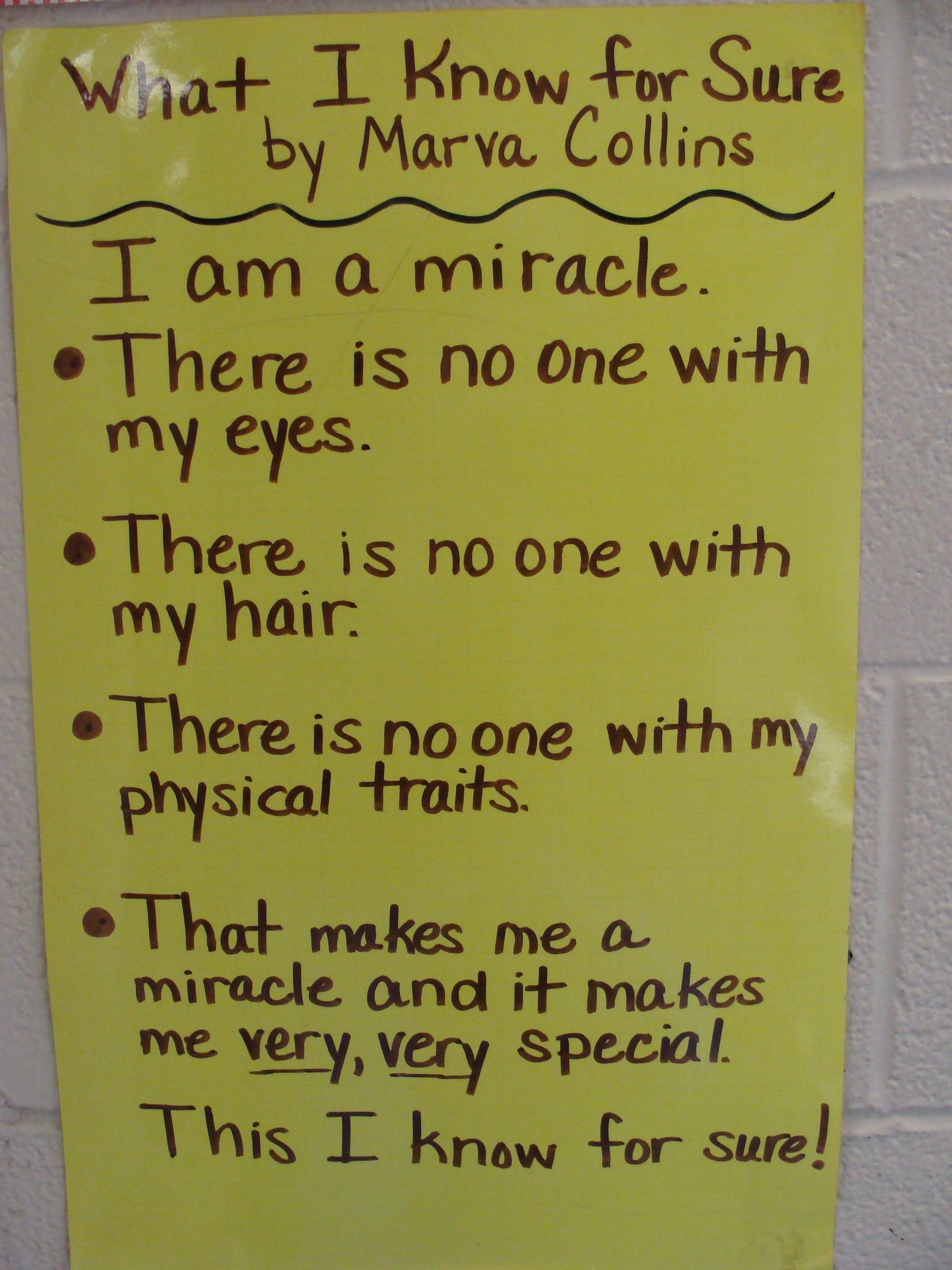
I have always been a big fan of Greater Expectations–a way of instilling high expectations in your classroom with positive statements, cheers, proverbs, and songs etc. From this workshop about ten years ago I got the following words for the posters shown below. Every year I place these poems outside my door so that students can see them when they enter. I make reference to the posters often to let students know how bright they are and that I believe in their ability to succeed.


How Do Your Students’ Personalities Affect Their Learning?
A friend of mine recently told me about a personality test that he had taken, and I listened with little attention thinking it was a time waster that he had found on facebook. After listening, I found out that several of my friends had done this personality test and that it was remarkably accurate. I gave the test a try and found out that my results, too, were accurate. Not only did I take the test, but I listened to the CD’s about the test results and learned so much about my own personality, faults and other people’s personalities around me. With what I learned from the personality test called The Color Codes, I now think back to all the different students I have had in my classes over the years. How students react to learning, responsibility, and to behavior management all hinges on their core color motive. While the color codes wasn’t created for children, but adults the same principals of the color code still apply. This would be beneficial for teachers to give to older children to learn their core color motive. So much focus is placed on getting to know your students records, families, multiple intelligences etc. at the beginning of the year–why not take time to learn about their personality. If you would like to take the color code test (its pretty short), click here. The free test will give you some good information about yourself, but the CD’s are really worth listening to and will help you understand your colleagues and students sooo much more. Just in case you are wondering I am a core white (peace) with other colors close behind. What color are you?
Build a Classroom Community Using These Books…
Building a classroom environment that is safe for taking risks creates an atmosphere conducive to learning. Max Lucado has written several beautifully illustrated books that are my favorites with which I begin the school year to foster a positive learning environment. You Are Special, If I Only Had a Green Nose, and You Are Mine teach children that they are special because of who they are. In these books, children learn they don’t need to follow trends or have things to be special. These books are part of a series, and I am sure that the others would be beneficial to use as well. If you use any of the others, let me know which ones you use and how you use them in your class.
Six Specific Procedures in Use…
I am attaching a picture of a classroom I visited for a lesson study. I took a picture of this poster because I was impressed with how specific the procedures were as the teacher had discussed them with her students.

Realizing procedures must be specific for students to follow is nothing that you are taught in college, but rather something that you develop over time as a seasoned teacher.
A teacher at my school recently shard an article by Lee Canter from his article “More Than Names on the Board and Marbles in a Jar” which I wish someone had shared with me when I first started my teaching career. I will share this excerpt from his article with you…
“First, whenever teachers want students to follow certain directions, they must teach the specific behaviors. Teachers too often assume that students know how they are expected to behave. Teachers first need to establish specific directions for each activity during the day ‑ lectures, small‑group work, transitions between activities, and so forth. For each situation, teachers must determine the exact behaviors they expect from the students.”
33 Classroom Procedures to Consider before School Begins

- How will students obtain a sharpened pencil?
- How will students line up?
- How will students take turns going to the bathroom?
- What will students do while waiting in line?
- How will students prepare when going home?
- How will students turn in homework?
- How will students communicate with parents?
- How will you record behavior?
- How will students work in centers?
- How will students work in groups?
- How will you get your students’ attention when they are doing an activity?
- How will students handle manipulatives appropriately?
- How will students turn in their work?
- How will students label their papers?
- What will students do when they arrive at school?
- Where will students place their backpacks and personal items.
- How will students sit appropriately when you are talking?
- How will students show you they are listening?
- How will students sit on the carpet?
- How will your rewards/consequences system work? What are the students’ responsibilities?
- How will students solve a disagreement?
- What will students do when they have a question?
- What will students do when they need to use the restroom?
- What will students do when they are tardy?
- What will students do when they are absent for missed assignments?
- What will students do with communication (notes etc.) from parents?
- What will students do if they are sick?
- How will students travel in the room?
- How will students address the teacher and other adults?
- How will students answer the door?
- How will students act when there is a visitor in the room?
- How will students use their voices when working in different situations (testing, cooperative groups, independent work).
- What will students do when another student is bothering them or bullying them?
Use This Festive Tool to Motivate Students Toward Goals
Are your students working towards mastery of their multiplication facts? their AR goal? or maybe some other goal? When your students in class are working towards a goal, use a string of large C9 Christmas lights to represent each child. Label student names on each bulb with a Sharpie marker. Unscrew the bulb so that it won’t light up until the child has reached the goal. When a child reaches his/her goal, then screw in the bulb so that it lights up. Eventually the whole string will be lit when all of the children reach their goals!
An Unusual Classroom Reward System
Instead of rewarding students with, classroom bucks, tickets, candy, or the like try using beads. Students earn beads for good behavior which they string in their free time to make a necklace. When students gain enough beads to string on their necklace, they are allowed to take the necklace home. Students may take all year to build their necklace. If you buy a variety of beads at a hobby store in bulk, then you may have some beads which are more sought after than others. For example, a soccer ball, basketball, or football bead may draw your boys’ attention. If you decide to implement this system in your classroom, you will have to have a place for each student to store their beads so that they are not a distraction, and so that they don’t spill easily. I used a small plastic cup (old country crock containers) hot glued to students’ desks. If students play with their beads when they are not supposed to then take some of their beads. This system does take some planning, but elementary students absolutely love it.