





Free Printable Number Discs
With second grade right now, students are doing a lot of place value activities and are using base ten blocks as well as math discs. I made these printable math discs for the kids to represent and compare numbers. If you would like to use them they are available for a download. I am copying the ones on white, the tens on red, and the hundreds on orange paper to represent the math discs. Students are going to cut these out and glue them down to represent a number.
How Do You Motivate Students to Learn Their Math Facts?
I am trying something new this year to help motivate students to learn their math facts. I heard about doing Math Wars from another math coach. Each class will give themselves a name for a team. The team could even be alliterated for more fun. For example, Mr. Bowers Brains or Ms. Elwick’s Elephants. Having the students take ownership in what they name themselves promotes more motivation to work towards the goal of learning their facts.
Classes challenge other classes to beat them on their fact races. Grade levels can challenge other grade levels too. For the first Math War at my school, I have decided to just have classes compete with other classes in the same grade. To determine the winner, I am calculating the total amount of items that are correct and taking a class average. This way all of the students are working towards doing better, and there are no tears or frustrations if all of them are not answered. Students will be answering all of the facts in the race, and I will give them two seconds per problem. If there are 60 problems, then students will have 2 minutes to answer all of their problems For the next war classes may compete outside their grade level; 4th graders may challenge 5th graders, for example. One of the teachers at my school suggested putting up schedules like when football games are played. So working with this suggestion, I have placed posters on the walls to add to the anticipation of triumphing over another team. This has added to student motivation since I hear students saying that “we are gonna beat Ms.____’s class”.
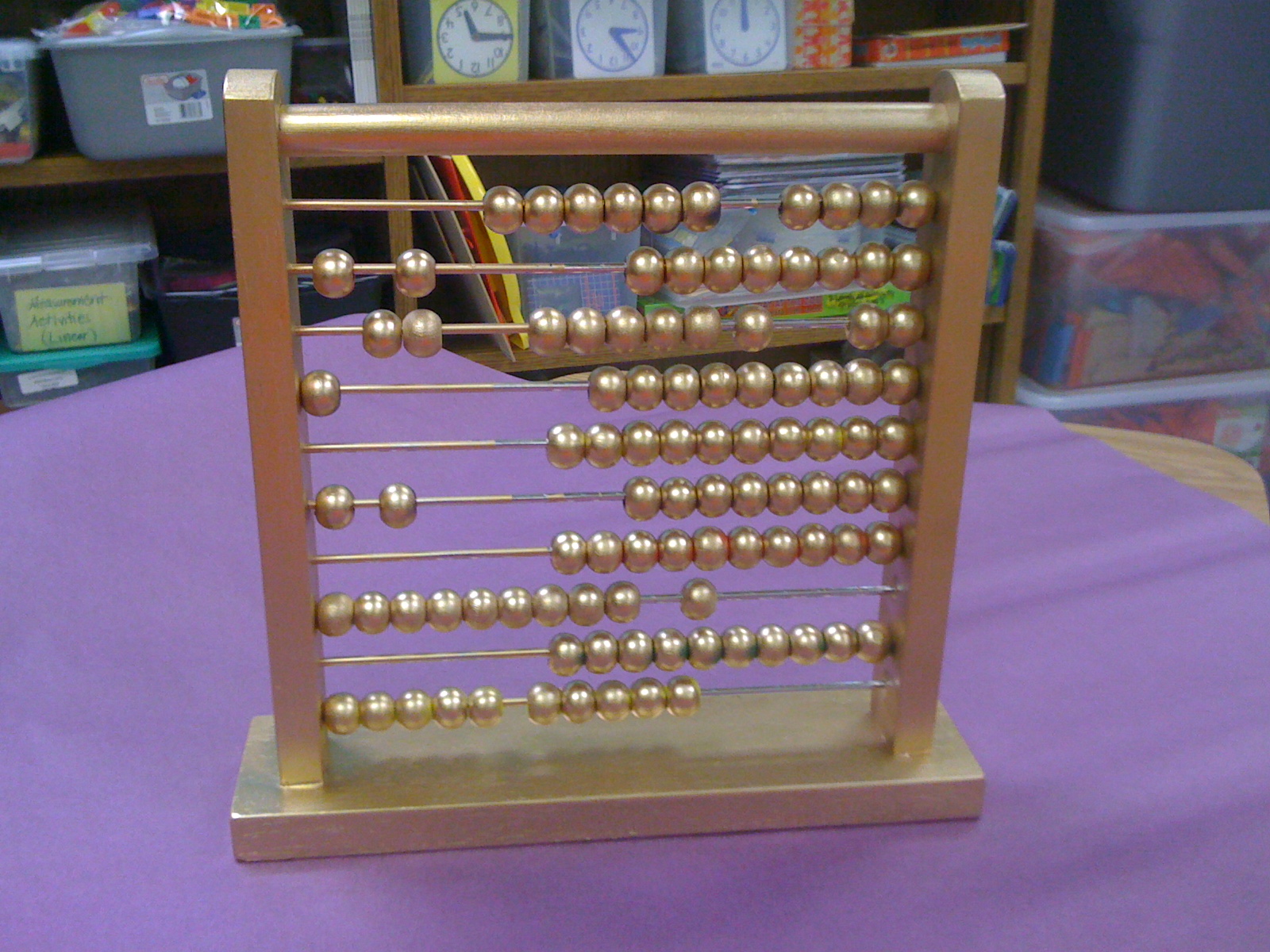
For trophies I tried to think of something that would reflect the idea of math and that I could spray paint gold. After brainstorming with several colleagues, someone suggested an abacus. So now I have the GOLDEN ABACUS (angels singing in the background). The golden abacus will be traveling to the winning classes and will go to follow the next champion. I bought several abacuses so that each winning class could have an abacus for each WAR.
Need an Engaging Way to Introduce Equations?
The first grade teachers at school absolutely love introducing subtraction and addition number sentences to their kids using the book Ten Flashing Fireflies by Philemon Sturges. I discovered this book in a lesson recorded in a Math Solutions book entitled Minilessons for Math Practice K-2. There is also a similar lesson (I think…not positive) in another Math Solutions book entitled Teaching Arithmetic. In the lesson students model the action of gathering fireflies into a jar using snap cubes. In the book there is a jar printable to use or the lesson suggests using a sheet of blue construction paper to represent the night sky. Not only is this lesson good for introducing the action of subtraction and addition, but it is also good for discussing one more and one less. Because this is such a beloved book that builds a great foundation for addition and subtraction, I worked on building this free SMART Board lesson to accompany the book this weekend, and so here is an example of this lesson. Just click to download the SMART Board lesson for free.


Wow, Cute Way to Chart Parts of Speech
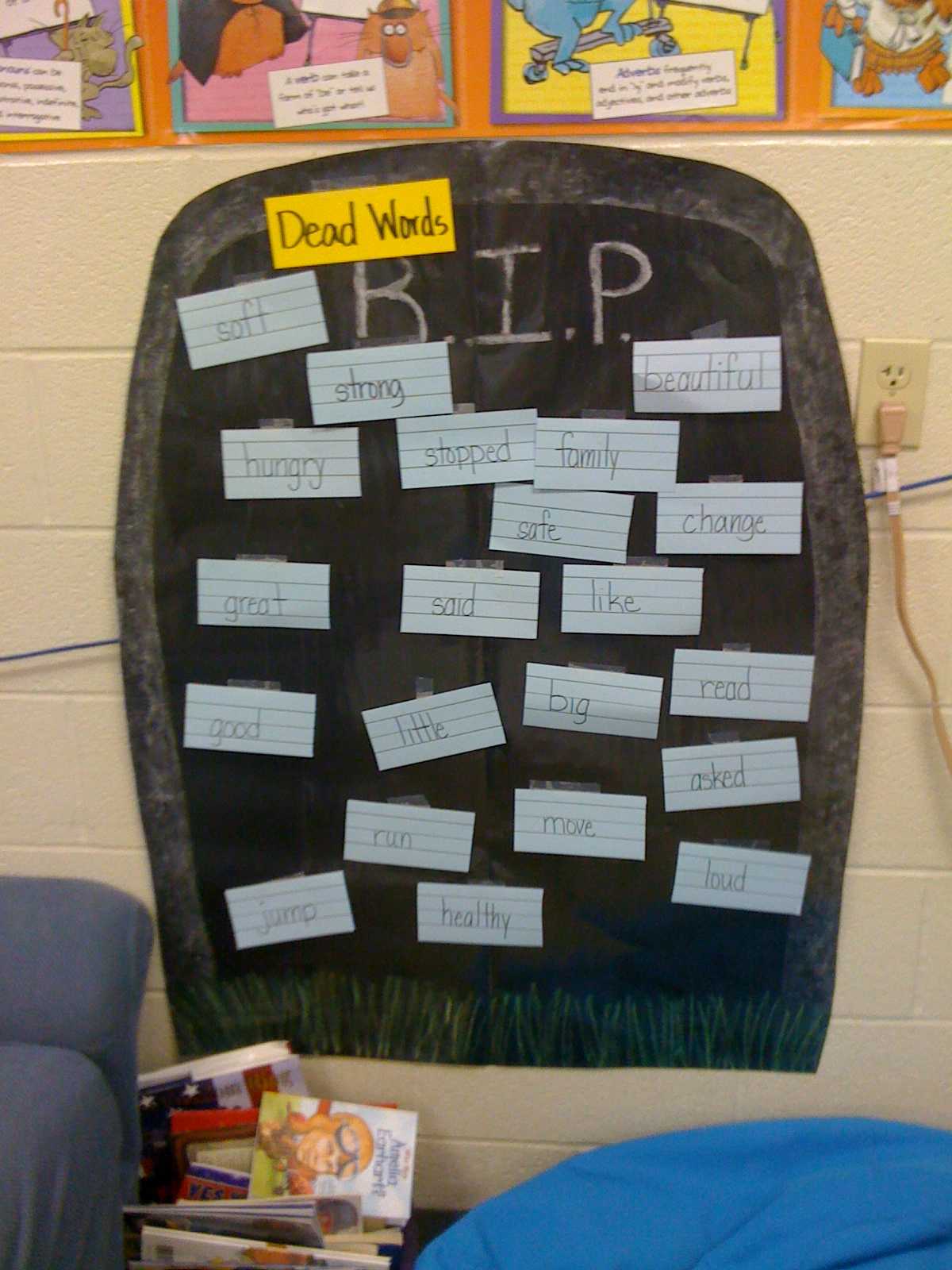
I came across these posters in a fourth teacher’s room at my school. She decided to display parts of speech on a shape poster to help students think about what types of words they use when they write. She made a poster for nouns, verbs, adjectives, and adverbs. She had displayed a house for nouns, a blob shape for adjectives, and the kite below for verbs. For some reason my other pictures didn’t turn out, but the kite picture managed to turn out, which is my favorite. Also, pictured below is another chart which she made entitled “RIP” for ‘dead words’ or words that are overused.

Quick, Cheap, and Easy Share Chair

Inside a First Grader’s Mind…
Today the secretary came to me and recounted the following story to me which had earlier occurred in the office.
‘Michael’ came to her with a scrap of folded up paper on which his phone number was written so that the secretary could change his personal contact information. He read the phone number out loud to her. As his eyes peered from behind the scrap of paper he read, “five, one, five minus six, two, two, seven.”
I am sure the secretary had a grin on her face when he finished. 🙂 I am just glad he can recognize his numbers.
How Can You Use Literacy to Introduce Multiplication?
I have come across Amanda Bean’s Amazing Dream by Cindy Neuschwanderin several of Math Solutions lesson books, however today is the first time I have read the book. It wasn’t until last year that the book actually was ordered for our library. The book is about a little girl who counts EVERYTHING. She counts so much that she dreams about counting. Her teacher and her mother encourage her to multiply because it works better for counting large numbers. Towards the end of the book Amanda realizes that multiplying REALLY is better than counting everything. This book would also work well for teachers who are using CGI strategies with counting collections because on each page there are multiple illustrations of objects to count like squares in window panes, food, wheels, legs, sweaters etc. Arrays and things that come in groups can easily be discussed after looking at the pictures. Now I am going to recommend this book to all the teachers who are teaching multiplication.

What Will Improve American Education?
With all of the talk about reforming our schools and standards, we seem to be changing the law but just trading one set of regulations for another. I, too, hope that the common core standards and current school reform leads us to better educating children. However, I just read an interesting article that addresses the spirit of the law which seems to be missing from our educational system. This article by Margaret Spellings of The Huffington Post makes the point that our nation has managed to lead the world in cutting edge discoveries in medicine, technology, and business yet still lags behind other countries educational systems. Spellings proposes several paradigm shifts in her article. If American public schools treated parents as clients, and parents were able to move students to the schools that best suited their child, then would the educational system improve? If teachers were paid not by a scale, but by the amount of work they did and by how skilled they were, then would that improve education? Ultimately, what if competition drove our school systems and the voice of the clients, would that improve American education? If the private business sector has become great on these principals, then wouldn’t it work for American education?
My Favorite Way to Introduce Division…
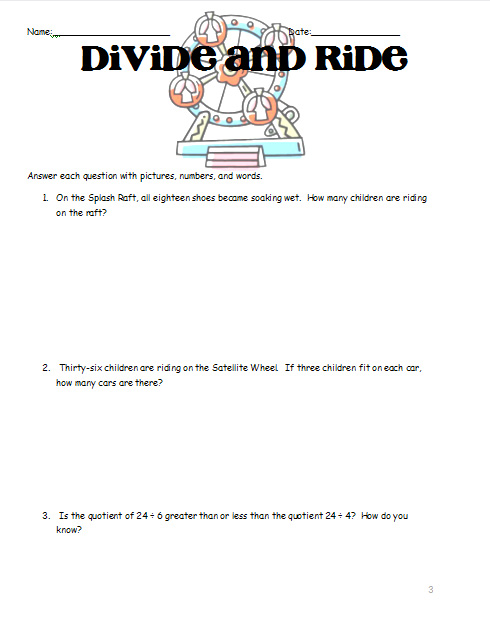
My favorite way to introduce division is with Divide and Ride which is a book by Stuart Murphy. I have posted about it before, but since many of you are teaching division now or soon will be, I wanted to share some of the sheets that I have developed to go along with the book. These sheets are in varying levels of difficulty. The first one is easiest and they get slightly harder. I have used them with different grade levels. The first one I used with second graders, but most of them have been used with third grade. The first question on most of the sheets is the same because it can be easily figured out with direct modeling…but if you have all of the sheets you could easily differentiate for your students since they are similar. The last sheet incorporates a question with remainders. Feel free to download them and use them for free. Let me know if they work well for your class.

What’s a Mathnasium?
I was listening to Kim Komando (the digital goddess) on nationally syndicated talk radio today as I often do, and a word caught my ear. She mentioned a Mathnasium! I, being a math coach at my school, had to wonder what it was. So I looked up a Mathnasium on line and found out that they are franchises that teach students math like a Sylvan Learning Center. They aren’t very well known yet, and they are international. Not all states have a site. This is a franchise which may interest you if you are burned out in the classroom and have a little business capital. Since they aren’t well known yet and there aren’t many locations, now would be an ideal time to get in on this business venture.