





Fill In Decimal Number Charts. Could This be the Answer?
Ok! So I won’t lie! I have struggled with the next teacher. Kids just fumble through decimals like there is a missing link. You try to have them do number lines, and they give you blank stares. You give them card sorts. They jumble all the cards up in the wrong order. They tell you the wrong answers almost always. There MUST be another way!! Well, 1 year later, I have finally put the pieces together.
Why can’t kids compare decimals? They are just numbers that follow a pattern with DOTS in them no less!
Have we ever stopped to look at the patterns that are formed when decimals are put in order. Have we stopped to reason about why the zeros drop off the ends of the numbers and they have the same value?
In kindergarten, first, and second grade, we have it somewhat figured out. For three years, students spend time counting and looking at patterns, and building numbers–for THREE YEARS. THEN BOOM! All of a sudden, they are supposed to draw their own conclusions about how to compare and round numbers that are abstract to them in 5th grade. So students CAN build decimals “reasoning about their size”, but where is the repetition that we give students in primary grades so that they can draw their own conclusions about the patterns. There is no counting standard that I can find…but maybe I just missed the standard or maybe I am just going on a rant here.
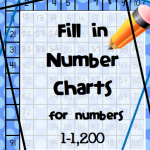
Anyway, I think students struggle with decimals, because we don’t give kids anything to hang their learning on…they have no foundation! I made some decimal number charts last year, but never really used them in depth. This year I made some fill in charts thinking this would solve the problem of students’ glassy eyed look when learning about decimals–AND NO…I’m not even talking about the kids on meds!! I really think that this is the problem…they need the foundation of counting before they can reason about decimals and move on to comparing, rounding, and ordering.
Because you are reading this, you obviously care about your students. You most likely wouldn’t be on the computer during your down time looking for materials for your kids. I am going to give you a few of the pages I made for FREE just because you care.
More charts are included than this single picture below.

I am also going to tell you about the pack of number charts I made that may help you even further. There are number charts for each section of decimal numbers counting by hundredths and thousandths. There is also a decimal number chart that counts by thousandths that is small enough to glue in students’ journals. Not only that, there are small number charts the same size as a base ten block that will help students put the concrete together with the abstract counting numbers as they place blocks on top of the charts. You can see a bit more below:


How Can You Motivate Your Class to Learn Math Facts?
This year, I have had the most competitive success when I have given attention to students progress on Reflex (an online math fact video game-like program for learning math facts–Read more about Reflex here). Each Friday, I pass out the reward certificates and recognize students who get a certificate at our morning meeting. Students who get a certificate also win a little prize with each certificate. What has helped the classes become most competitive is the bar graph I have hung in the hallway. Each class name is at the bottom of a bar. I update this graph nearly daily. Every time students go down the main hallway, they look to see if their class has grown on the graph. I have placed the graph below…

As you can see the taller bars are the 3rd-5th graders which have gotten VERY competitive. On our last contest 1st, 2nd, and 3rd place were only 1 point away from each other! I took a picture of the classes who won on the last contest to place beside the graph. I personally reward the 1st place classes with a party. This time I was so proud of the special ed class who won 1st place!
In addition to the above graph, one of our teachers has developed a class thermometer for her individual class competition out in the hallway. She moves each student’s name on a clothespin closer up the thermometer to 100% fluency each week.
I am not paid a dime to say this, but I must say Reflex math is the most effective tool I have ever used to teach math facts!
I must be honest. I hope the wall isn’t red underneath the paper at the end of the year. I think that every time I color on the paper to fill in the bars…the paper is kind of thin.
I Must Confess…
I have been less than focused during this Christmas break. In fact I’m just now going to wish you all a HAPPY NEW YEAR!

I’m just now hearing the latest edition of The Bachelor is coming on–2 hour special–whaaaaaat?! 🙂 –so easily distracted! I hate to admit my addiction, but I can’t stop myself from watching!! Then back to work tomorrow…bye, bye rest and relaxation. I really enjoyed your visit.
Now onto something more productive and helpful…
I meant to share this a lot earlier, but like I said…I haven’t exactly been focused…
In case you are teaching clock time soon, I wanted to share this fun idea you can do daily, and it doesn’t take a lot of your class time. First, hand out different times on cards to your students that are in 5-minute intervals starting out with when students are in class. Leave out any times that students are out of the classroom like lunchtime and recess. For example, if students arrive at school at 8:00, begin writing times on your cards like 8:05, 8:10, 8:15, 8:20, etc. Then give one card out to each student. Instruct your students to yell the time out when the clock hands are on the card’s time no matter what is happening in the class. The student can interrupt anything while yelling out the time. While this sounds disruptive, it surprisingly isn’t. Students are so proud to tell the time and end up watching the clock all day. If sitting in cooperative groups, students watch for the times of the other kids in their group, too, giving them extra practice. I used to do this with simple index cards and wrote the times on them with a marker.

Since then, I have made them prettier and they are for sale on TPT in my time unit. One of the teachers at school who printed these put them on colored card stock, colored the border with marker, and hot glued them to a popsicle stick. Whether the cards are pretty or whether they aren’t, the kids love this activity. This can be repeated for several days if you just pass the cards around to different students so that students get practice with a different time. You can also differentiate by giving the easier o’clock and half past times to your struggling learners.
I hope you can have fun with this in your class like I have mine :
Merry Christmas!
I wish you all a VERY…

from Ms. K at teacherblogspot!
Would This Help Students Learn A.M. and P.M.?
I was in a meeting one day and snapped a picture of this wall clock. I thought labeling a clock like this would make a great addition to teaching about A.M. and P.M. because the kids can actually see the A.M./P.M. hours on the clock just like military time. I haven’t tried this. What do you think? 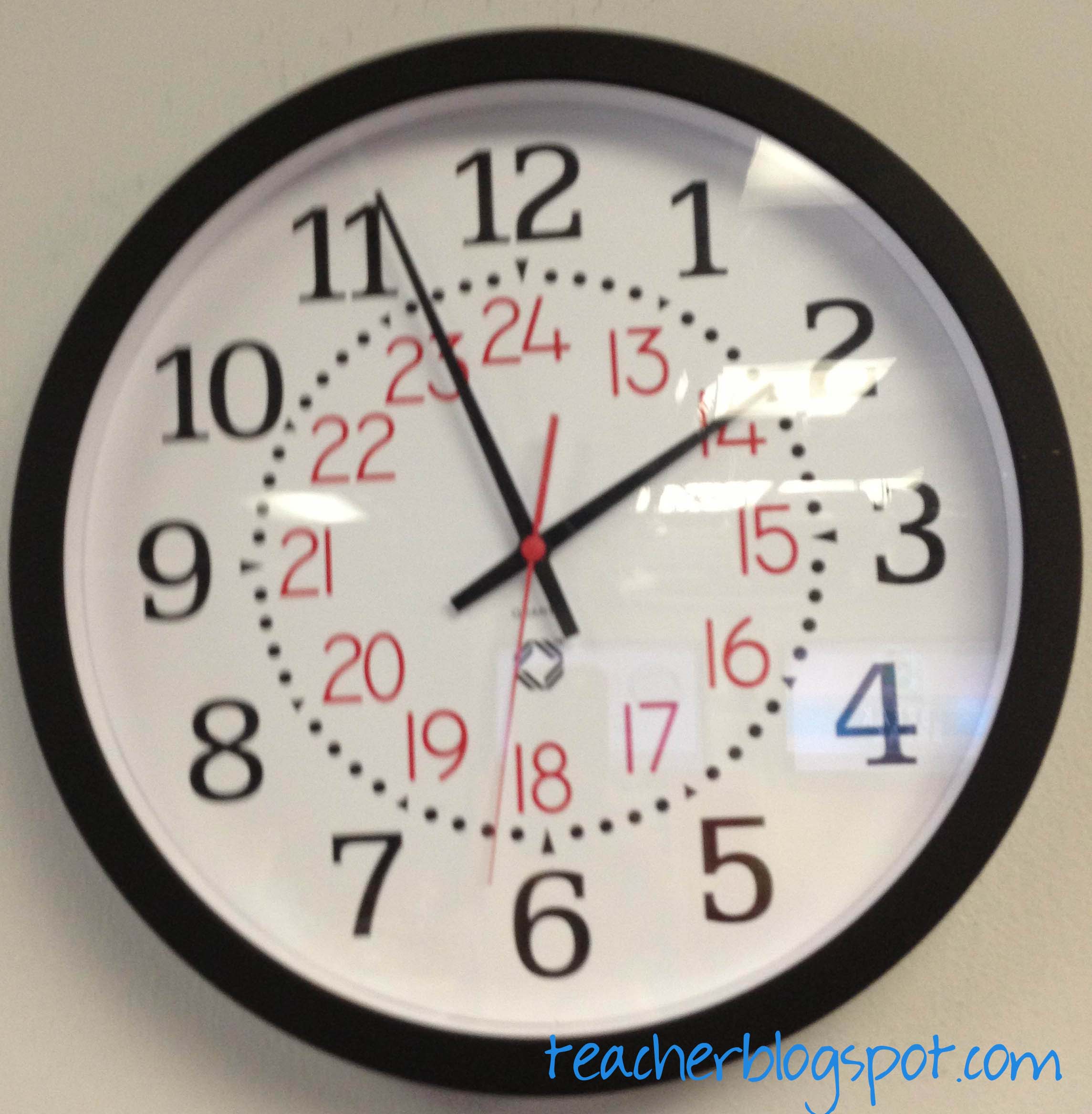
What Hour is the Hour Hand REALLY showing?
When students learn about time on an analog clock, I can predict what they will confuse every year–I can predict it better than the Farmer’s Almanac predicts a cold winter.
Problem Number 1. They will mix up the hour and minute hand.
Problem Number 1 Solution: Once a child told me how he thought about the hands on a clock . What he told me is better than anything I have told kids. He said that the long hand is long because it is trying to reach the marks on the edge of the clock–therefore it tells the minutes. The short hand is shorter because it is only trying to reach the numbers and they are much closer. Now that I learned this from a 3rd grader I tell students this every year.–If what a kid said ain’t broke, don’t fix it!
What this 3rd grader said made better sense than any little ditty rhyme I have told kids, such as the “Short hand has all the power. That is why it tells the hour.” This little rhyme is great fun to say, however because short doesn’t rhyme with anything, I could just as easily confuse the long hand in this rhyme.
Problem Number 2. They will think the hour hand goes to the next hour when it gets close to the next number.
Problem Number 2 Solution: After much frustration with students thinking 7:50 was 8:50 and so on, I came up with this idea. I had them color their paper plate clocks in sections and color the number before the same color. Then I explained how all of the same color belongs to the same hour number. Below is a student clock sample of this. (I wrote over the child’s numbers with a sharpie so that you could see them in the photo.)
I further explained that as long as the tip of the hour hand is in a section, it belongs to that color and the matching colored number before that section. The numbers have property and their property is behind the number with the matching color. In the example above, the hour hand is closer to the 8 but belongs to the 7 because its tip is still in the yellow and the number 7 is also yellow–so the time is 7:55 and not 8:55.
Side note: I prefer that kids color their clocks with more than two colors because I think it causes less confusion to the eyes. I believe 3 -4 colors are best. (This teacher chose to just use 2 crayons with her class.)
More lessons on how to effectively teach time with as few misconceptions as possible (including instructions on how to make this clock above) are included here in Telling Clock Time Lesson Plans and Activities on TPT.

Come back soon for more about teaching time!
Teaching Coordinate Grids? Try These Great Resources!
A fabulous fifth grade teacher I work with started using these coordinate grid mystery pictures with her class from Super Teacher Worksheets. She said that her kids who struggled with everything else in math, loved these and were so engaged in finding the coordinates. There are many different mystery pictures that you have to pay for on their site, but I want to call your attention to a Santa Clause mystery picture that is absolutely free 🙂 especially since this is the week before Christmas! We all know how kids are the week before Christmas break–ahem–let’s just say they need something super engaging!

I also just finished revising a coordinate grid activity that I made a while back. Students must locate buried treasure on a coordinate grid using geometry and graphing terms. Our fifth graders are enjoying this activity right now, too! This activity packet is available on TeachersPayTeachers.

Social studies can be discussed with this activity since the grid has a map behind it. I like to discuss coordinate graphing on the same days I am teaching map skills in social studies because the two are so similar. This activity doesn’t explicitly teach social studies, but there is definitely room for some discussion about the maps and what part (or state) the treasure is probably in.

Support Kids and Enjoy Christmas Music at the Same Time!
I know I can usually be found stooping over the $5 bin of Christmas music in Wal-Mart this time of year because nothing brings the feeling of Christmas around more than Christmas music!! Because of this I want to share with you some beautiful Christmas music that a friend of mine wrote. All of the songs are ABSOLUTELY, breathtakingly, beautiful! They have the sound of the Transiberian Orchestra! The whole album is only $5.99, and it was just released today–December 1–to download on iTunes!! The special part about the album is that half of the proceeds are given to charity–St. Jude’s Children’s Research Hospital, Arkansas Children’s Hospital if you purchase the album through iTunes . That means that you are giving sick children $3 and really only paying $3 for the music itself. Below is a video about why the writer is giving half of the profits to charity. I’ve already downloaded mine!! 🙂

How In the World Do You Teach Rectangular Arrays and Division in 4th Grade?
Well, with large numbers this is something that my fellow colleagues did not feel comfortable teaching. And when that happens…who steps in?? None other than The Mathemagician…ta-da! (which is me of course, but shhh don’t tell anyone!!)…I’ve been off for a few days as I write this, which makes me a little sillier than normal–and probably slightly more interesting! So, on with my lesson! Now just remember when I post these pictures it is not a beautiful, I spent weeks preparing, colorful, lesson. This is a practical lesson anyone could use whether you are savvy with a computer or not. (I may turn this lesson into something more aesthetically pleasing later on.) The part that stumped the teachers was the fact that the standard says “up to 4-digit dividends”.
CCSS.Math.Content.4.NBT.B.6 Find whole-number quotients and remainders with up to four-digit dividends and one-digit divisors, using strategies based on place value, the properties of operations, and/or the relationship between multiplication and division. Illustrate and explain the calculation by using equations, rectangular arrays, and/or area models.
I had to think myself about how to teach this before I spouted off a lesson idea. (I know I am supposed to be the math expert in my building, but, honestly, I have to look up what exactly common core is expecting before I assume I know what a standard is asking students to do.) I looked at North Carolina Unpacked–my go to document for what common core expects…


 .
.