






Teach Area–Yum, Yum!
Lower elementary students must calculate the area of a shape by counting square units. Inch tiles work well for this if students are calculating the area of a rectangular shape. However, if you want to make your lesson extremely engaging give your students Cheez-its or square Starburst candies which measure an exact square inch. Students will eagerly measure their square units using these yummy manipulatives knowing they can munch on them later.
Teach with Style (at a discount)!
Look stylish while you teach! One of my favorite stores Ann Taylor Loft offers teachers a 15% discount off of their purchases. Just show proof that you are an educator with a pay stub or your teacher’s badge to claim your discount. Unfortunately this discount doesn’t apply to the regular Anne Taylor stores only Anne Taylor Loft participates in the teacher discount offers. To gain even more of a discount, see this link to get additional coupons for your next shopping trip. http://www.bradsdeals.com/stores/ann-taylor-loft-coupons
Will Teachers Be Replaced with Technology?
As a result of the millions of dollars in philanthropy Bill Gates has poured into education many advances in educational technology have been made in the U.S. Some examples of what Gaters has contributed to are as follows. Video games are being developed by Quest Atlantis to help students become proficient in math, science, and literacy. Sal Khan, a former hedge fund manager, began developing You Tube videos to help his younger cousin in school. These videos received much more anticipation that Khan expected. So much attention that Gates’ children viewed them to help them with their math. Google and Gates then both helped Khan develop the Khan Academy. Some teachers are using Khan’s videos as homework for students to watch while they spend class time in a tutoring like atmosphere. Online learning is gaining popularity in India and in Florida as students retain more information with the differentiated one on one instruction a computer provides. Studies have shown students still need adult supervision of their learning in a computer lab, so if teachers are less depended upon for instruction, their title may become intellectual coach or research assistant. For more about this topic, follow the links:
http://www.fastcompany.com/1750540/bill-gates-takes-on-educations-biggest-bureaucratic-beast-with-video-games?partner=rss http://www.fastcompany.com/1722914/can-computers-replace-teachers.
Do Manipulatives Make too Much Noise in Your Class?
Clink, Clank times twenty-five students can create a deafening noise in combination with twenty- five low voices, so try this to quieten your classroom. There is the obvious use of the less durable, new foam manipulatives. Then there is the option of giving every student a sheet of felt to soften the noise of plastic or wood manipulatives. However, if you use felt, it has a tendency to slide around too much on students desks. Recently a fourth grade teacher shared an idea with me which I had never thought of…use the foamy-type liner (without the peel off sticky backing) that you buy to line your kitchen cabinets. Cut each student a rectangle to use for their desk. This type of contact paper doesn’t slide!
Countless Quality Teacher Blogs
Prepare to be inspired! If you are looking for quality teacher blogs, you will find countless quality blogs at the following link here. The blogs are grouped by grade levels preschool- twelfth grade. Special education blogs are even included. Some blogs are not grade level specific but address a specific content area. Happy reading!
Are Your Students Struggling with Traditional Long Division?
Generally it takes students a few weeks initially to learn division– especially long division with multiple digits. Marilyn Burns’ book Extending Division has several helpful hints within her lessons. In place of the traditional method for division, she shows how to teach students with the ladder method in which students divide a dividend with multiples of ten rather than break the dividend apart like the traditional method. The ladder method helps students understand numbers more effectively because they are estimating and thinking of the dividend as a whole. See this example to gain a better understanding of the ladder method.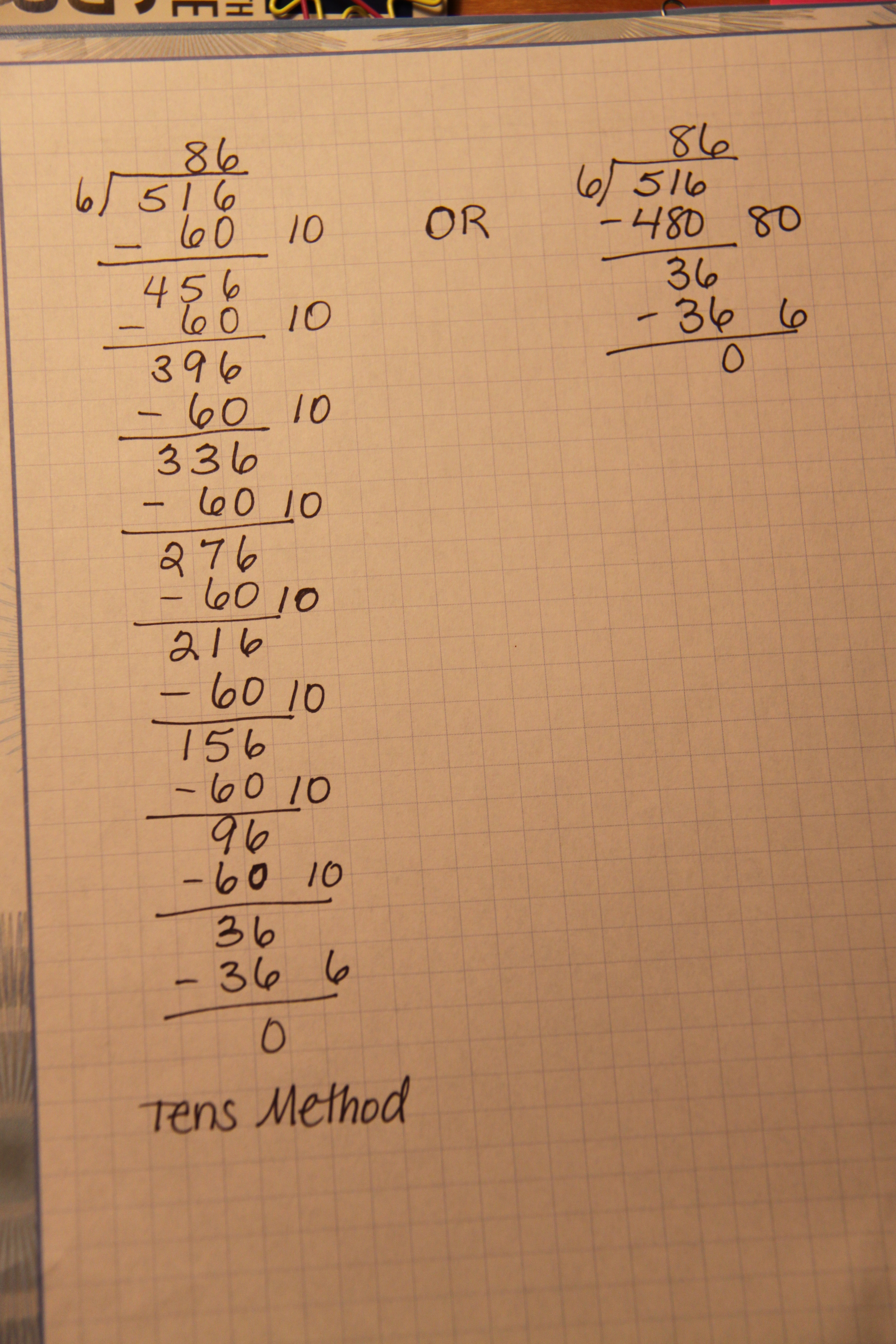
Add all of the numbers to the right (the ladder) to find the quotient.
Can You Hear Me Now?
Verizon offers a teacher discount off of your cell phone service. Try signing up at the following link: http://www.verizonwireless.com/b2c/employee/emaildomainauthentication.jsp. If the previous link doesn’t recognize your email address, just show your pay stub or teacher id when you walk into your local service store and they will help you obtain your discount.
Pushing Three-Year-Old Students to Learn before Kindergarten
The New York Times recently wrote an article about a new learning center called Kumon which is emerging on the horizon of U.S. education. Kumon is similar to a Sylvan learning center as it gives students individualized sessions to meet their areas of need. They also help school aged children (K-12) become more advanced in math and English skills. Some controversy surrounds the learning center because they accept three-year-old students or any child “out of a diaper [that] can sit still with a Kumon instructor for 15 minutes”, states Joseph Nativo, the CFO for North America. Many parents believe that a child that young should learn by exploring and playing instead of the drilling methods to learn letters and numbers that Kumon uses. Kumon believes that learning basic skills increases children’s self esteem which leads to success in their learning. To read more about this article, see the following links: http://parenting.blogs.nytimes.com/2011/05/16/pushing-kids-in-public-and-private/ and http://www.nytimes.com/pages/education/index.html “Fast Tracking to Kindergarten”.
Molding Cooperative Groups into COOPERATIVE Groups
In a former post I introduced using a classroom economy (Bonus Bucks) to teach responsibility and self management. Click here to read this post. There is also a larger size of Bonus Bucks which you may use for cooperative groups. The size of this Bonus Buck is almost the size of a sheet of paper. When groups are displaying appropriate cooperative behavior, walk by a team and place one of these large bucks in the center of the table while complementing the team’s behavior. This large reward display encourages other teams to display the same appropriate behavior. To avoid arguments, allow the team captain to hold the buck until the buck can be cashed in for smaller bucks for each team member at a designated time. To see more about Large sized Bonus Bucks click the bonus buck below. I have placed Bonus Bucks, a parent letter, a cooperative Bonus Buck, classroom job tags, and directions for using Bonus Bucks in your classroom on TPT.

Are Your Students Struggling with Telling Time?
When teaching students to tell time, first have students make paper plate clocks with only ONE hand–the hour hand. Approximate time can be told with only an hour hand. Discuss that when the hour hand is half way between the numbers on the clock that it is on half an hour. For example, if the hour hand is halfway between the two and three, we know that it is 2:30. If the hour hand is between the two and three and closer to the three we know it is probably 2:45 or later. Then show students different times with only the hour hand and have them tell if it is before or after whatever hour. Giving students quality time to learn the function of the hour hand will help dispel misconceptions that may form from learning time with two hands at once and not truly understanding each hand’s function.