





Woo Hoo! Teacher Appreciation Sale on TPT!
Here is your chance to stock up on many fabulous goodies for your students on TPT before summer is here. I will be offering all of the items in my store for 28% off on May 6th- 8th. Also, many other sellers will be offering their items for 28% off as well. Just grab the promo code below as you check out.

Do Your Kids Need a Dawning Division Moment?
After sitting in a week’s worth of meetings about Common Core instruction and best math practices, I feel as if my way of instructing students is gradually morphing into a new beast, which I am not sure I fully can describe yet. In the midst of all of this, I went back to the fifth graders I have been working with on the day after these meetings. I decided to try out some of the teacher practices I had been learning. Sidenote: This set of fifth graders isn’t yet proficient at long division or ladder division for that matter. I posed a long division problem to the students, but instead of giving it to them in “naked numbers” alone, I gave it to them in word problem form as well. In reflecting, I should have started out with the word problem alone and let the students figure out that they were supposed to divide. After watching the students struggle with solving using ladder division or the traditional long division algorithm, I encouraged the students make equal groups to see if that helped them. One student in particular that I worked closely with (whose work is pictured below) managed to find a correct answer using equal grouping, however he could not find his mistake when he used ladder division. Another student…one I might add who typically doesn’t have much perseverance to solve problems…related completely to the contextual situation and persevered through to solve the problem to the end. To get to my MAJOR DIVISION REVELATION, let’s look at this student work below:

One student's incorrect ladder division and solving with equal grouping correctly.

The same student's equal grouping and the relationship to the correct ladder division which I showed him. Notice how 20, 30, 10, and 5 are the same in the circles and to the side of the division problem.
So, you ask, what is the big AH-HA? If you notice that the numbers in the student’s circles (equal groups) are the same numbers to the side of the division problem (or the ladder). The numbers to the side of the ladder are actually the chunks that students would naturally break off if they were naturally dividing cookies among people etc.! Now I know according to my PD classes that I shouldn’t have just told and shown the student this relationship, but I should have allowed him to figure it out. I was just a little too excited to hold in my own personal discovery I suppose.
Another discovery I had in experimenting with having students discover their own strategies, I learned that students actually do better and persevere more when the problem is in a context familiar to them and it isn’t just a naked numbers problem. Having a contextual situation actually gives the students an entry point into the problem, and so they don’t give up as quickly. I have always thought backwards. Students MUST UNDERSTAND THE NAKED NUMBERS FIRST and THEN they can SOLVE HARD WORD PROBLEMS. But in reality after my experiment with these fifth graders, they were much better at solving this division problem in their own way when they had a context. I have had a complete paradigm shift, and you were all here to see it above– that is.
My New Singapore Math Manipulatives!
I get the luxury of ordering new math materials for my school. To prepare for all of the common core instruction in place value, fractions, and decimals, I ordered lots of fraction circles, some more unifix cubes, and some place value strips. When my order came in this week, it was like Christmas! That is always the feeling I have anytime I rip open boxes of new math materials! I am most excited about the place value strips which are pictured below. As you can see in the pictures, they come apart so that students actually see the value of the number. These are one of the Singapore Math manipulatives. Each color matches the Singapore math discs if you decide to get those as well which I use with 1st, 2nd, and 3rd grade. If you want to have a smaller size, there is also a copy, cut and laminate version in one of Sandra Chen’s books, The Parent Connection for Singapore Math.

Place Value Strips
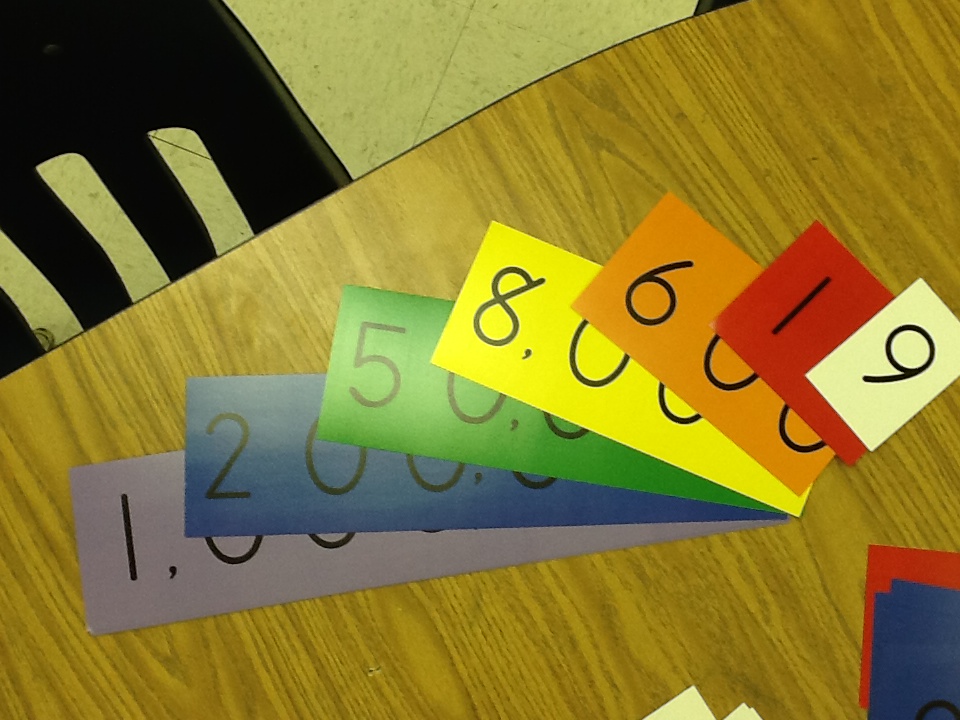
Place Value Strips Showing the Value of the Digit
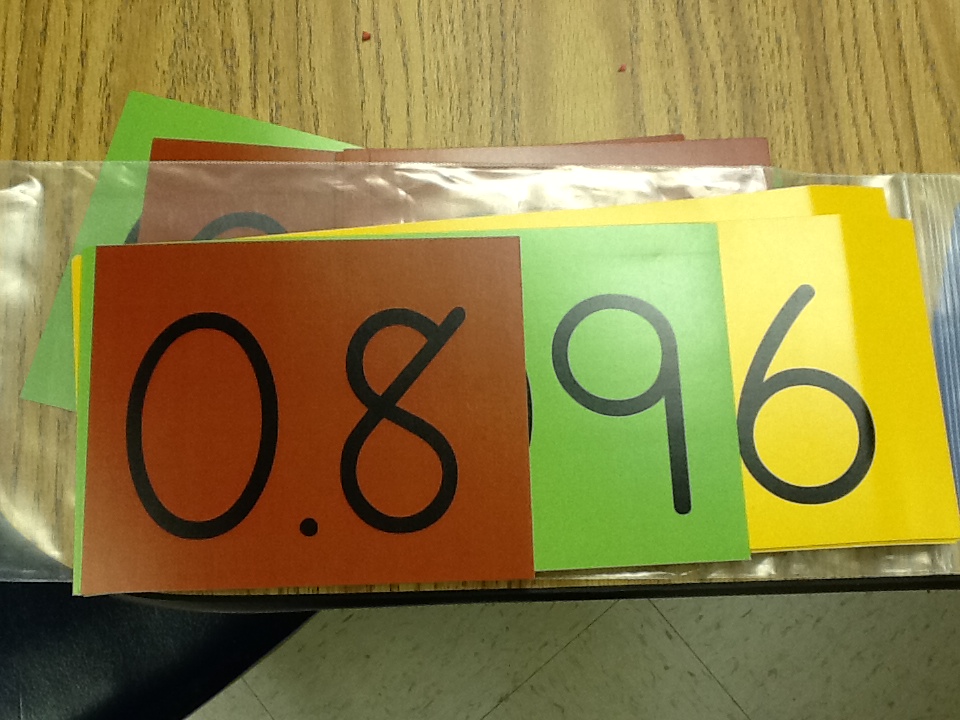
Decimal Strips
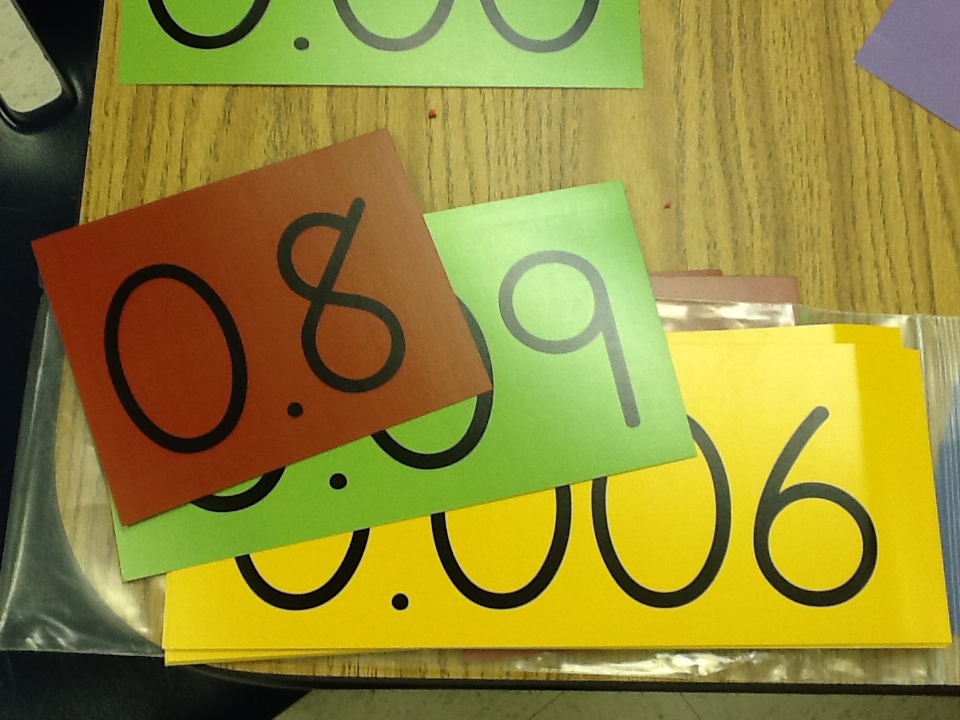
Decimal Strips Showing the Value of the Digit
Free Test Taking Rubric or Checklist
I showed the fifth graders that I have been teaching for the past few weeks this page before they tested. I let them know that I was going to be looking for these actions or test taking strategies while they tested. Our principal gave the students extra recess time at the end of the day if they worked hard on the test all morning long. I wanted a way to measure “working hard on the test”, so I used this checklist/rubric. If students did 4 of the 6 actions or testing strategies listed on the sheet, then they were able to have extra recess. Across the top of the page the categories read:
- Underlined Key Words
- Brain Dumped— Writing important information down on the math reference sheet that they may forget
- Eliminated Wrong Answers (on multiple choice)
- Used P.E.C.E (an acronym that stands for using a picture, equation, complete sentence, and elaboration to solve an open response)
- Persevered When Problem Solving
- Checked Work or Used the Entire Time to Work
If you would like to use this form, you can download it for free here. I am posting it in Word format so that you can open it and change the wording to suit your needs.

Testing Rubric Checklist
Do You Need a Fun Way for Students to Experience Perimeter, Area, or Volume?
Students built the following houses out of food items and then calculated the perimeter of them. We did this project as a relaxing activity after testing. I allowed students to build houses out of graham crackers, frosting, red hots, marshmallows, and Smarties. Then they used a measurement tool to calculate the perimeter in centimeters. If I had really wanted to use this activity to stimulate mathematical thinking, I would have had the students calculate the surface area and the volume using large marshmallows. Since I just wanted the kids to take a fun break after testing, I didn’t have them calculate anything except the perimeter. If I had to pick their favorite after testing activity from this week, this would have to be it!

One of the most creative houses the kids built. If you look on the napkin, you can see the perimeter calculations.
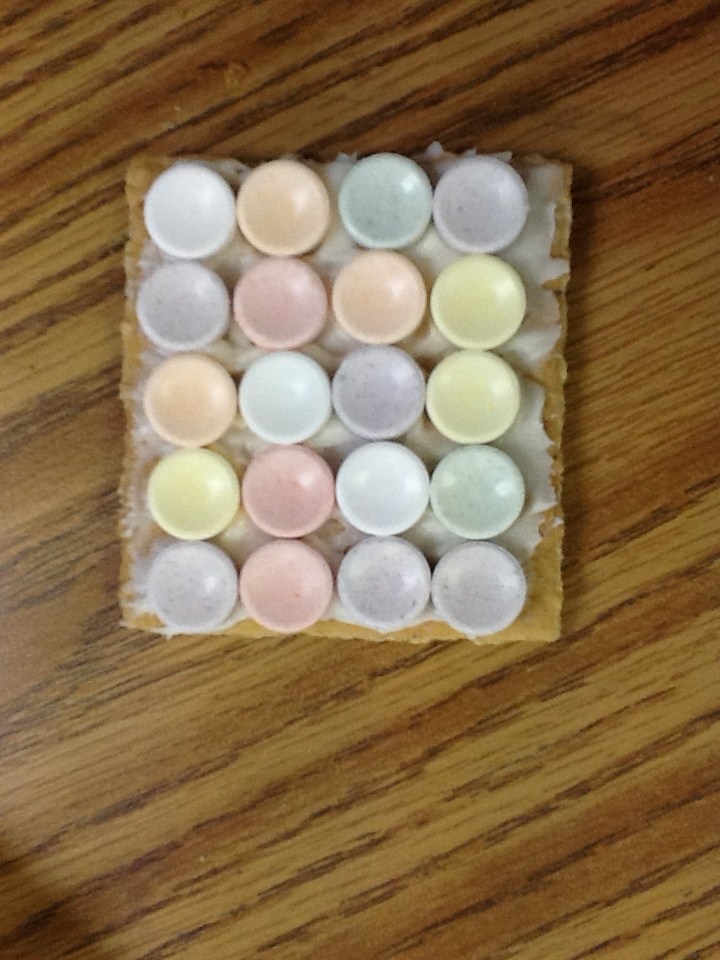
One student discovered an array with her Smartie shingles!

Measuring perimeter of the graham cracker house with a base ten rod. (each unit is a cm)
Yummy, Fun, Math with Circles!
I did this today to reward students who had put forth their best effort on our state tests. Originally, I had just planned on bringing cookies, but we had just been studying the different parts of a circle. Cookies being round just naturally lent themselves to be used for this spontaneous activity. I bought some Twizzlers and told students to use those to separate the strands to use for the chord, radius, and diameter. A spoonful of heaping icing was distributed to each child to help all of the parts stick. Students got red hots to use for the center of the circle. According to the common core standards, unfortunately, the parts of a circle will no longer be in the curriculum for fifth graders after I came up with this nifty activity :(. Maybe a teacher somewhere out there that teaches middle school students or older could benefit from this in the future. Below are pictured the circles with their Twizzler radius, diameter, and chord. In reflection, if I were to do this over I wouldn’t have bought Twizzlers. I would have bought those individual licorice colors that are single strands. I saw a package at Walgreens after I had already bought the Twizzlers. I think those would work better because they are already single strands AND I could have differentiated what I wanted students to use for each color. For example, make your chord red, your radius blue, and your diameter yellow licorice. If students did this, then I would really know that they could distinguish between the parts. All in all, the students ATE THIS UP–literally!

A student who followed directions and separated the strands of licorice.

And a student who didn't quite follow directions with the Twizzler strands still stuck together, but recognized the parts of the circle nonetheless. These cookies were a little crumbly from their trip to school. Hence, the imperfect circle shape.
How Can You Use Pattern Blocks to Simplify Fractions?
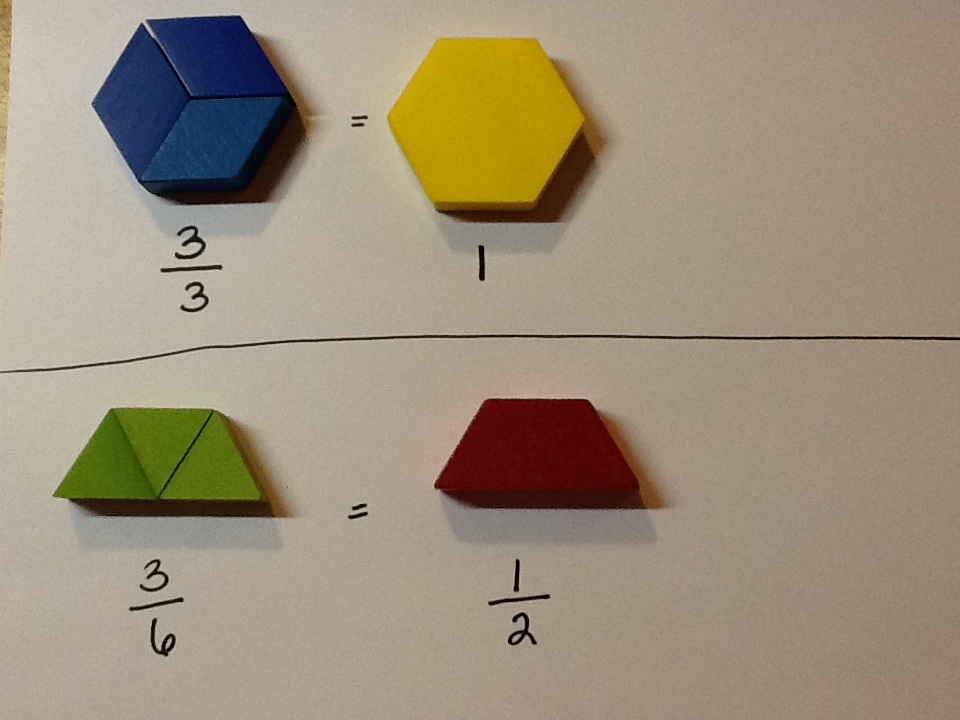
Use pattern blocks to help students find equivalent fractions. Students simply take the blocks and trade them in for larger and larger blocks until they can not use any larger blocks to make the same shape. See below for some examples. The first row shows the blocks as fractions of 1 hexagon.


To make using hexagons for fractions more engaging, call them cookies since they are yellow and the size of a cookie. There is a TERC math investigation lesson called “Hexagon Cookies” which is in the Fair Shares book (for 3rd grade). Hexagon Cookies makes a great lesson to teach previous to simplifying fractions with the pattern blocks.
Fabulous App Find!!
I just discovered a new app called Show Me similar to an interactive white board on the ipad. A kindergarten teacher shared with me today how she uses this app in her classroom. She uses a class set of ipads and has the students record themselves talking as they are solving math problems. The app has the ability to record the students’ voices and actions on the screen as they are thinking through their problem. Students can write on the screen with their finger or a stylus in several different colors while they are solving their problem. Pictures can be imported from the ipad files or you could email yourself a picture from another file to have it on your ipad. For example, if you wanted to solve problems with color tiles, then you could build some colored squares in another program and email them to yourself. This particular kindergarten teacher, however, explained how she had students solve CGI problem types on the ipad while they recorded their voice and writing on the screen. She did this in order that she could hear their thinking because she wasn’t always able to make it to every student to hear their thinking. Later she would take the ipad home so she could hear the students solving their problems.
A Simple, Quick Activity to Make Area, Perimeter, and Volume “Click” with Kids
Every year the same thing happens. Students get area, perimeter, and volume confused. Several years ago I went to an NCTM conference and a presenter there suggested this activity. I kind of made it my own since I have been teaching fifth grade a lot lately. She suggested taking index cards and labeling them “AREA” and “PERIMETER”. I added “VOLUME” also. Then read aloud several statements and have students hold up the card so that all including you can see. I had a list of about fifteen statements such as:
- How much sand to fill up a sandbox?
- How far is the distance around the playground?
- How much bulletin board border do you need to go around the bulletin board?
- How much paint do we need to cover the classroom wall?
- How much fabric do you need to make a tablecloth to cover the table?
- How much water is needed to fill a swimming pool?
- How much carpet do I need to buy to make a comfortable reading center?


We did this orally in class for about fifteen minutes and after each statement, I asked the student why the answer was what they held up on his or her card. Sometimes instead of asking why the answer is perimeter, I asked why is the answer not area or volume. At first when we did this activity students had mixed answers and I could tell that they didn’t have an understanding of these terms. After spending a while explaining why or why not an answer was correct, I noticed that most of the students were correct as they held up their cards. I had thought of giving the students three different colored cards so that I could easily tell which word they were holding up, and then I changed my mind. I decided that if I could quickly tell which card that students were holding up, then other students would simply look at the color of the “smart” kids’ cards and not do much of their own thinking.
To extend this activity, I had students keep their cards in their notebooks and add to them the next day. On the back of the perimeter card, students wrote “UNITS”. On the back of the area card, students wrote ” SQUARE UNITS”, and on the back of the volume card, students wrote “CUBIC UNITS”. I used the same fifteen statements and had the students hold up the cards just as before, but this time with the units side facing me. Doing this helped them see the connection between perimeter, area, and volume with which type of units each measured.


After these activities most students were holding up the correct card and had the general understanding that:
- perimeter and units measure distance
- area and square units cover
- volume and cubic units fill.
This activity could be used in other disciplines as well if students are struggling with the meaning of a few terms. The beauty of this is you as a teacher have an immediate quick assessment for students who aren’t understanding as soon as you see their card.
Nothing But Nets!
Here is a little something I have been working on–Nothing But Nets. I recently posted this on TPT. I used this to teach a fifth grade class about what nets worked to build a cube without overlapping. Before I used this lesson, I gave students some grid paper and asked them to find as many ways as they could to build a net for one cubic unit. Then we posted all of the nets–ones that worked and ones that didn’t on a chart. We grouped the nets into two sections so we could see the similar characteristics that made a net work or not work. We gathered on the carpet for an up close look at the similarities among the nets. Students made some good generalizations about what would make a net work such as the net must have 6 squares and be flexible enough to surround the cube. Students also made generalizations about cubes that didn’t work. Among students comments were these generalizations–they noticed nets that don’t work may have more or less than 6 faces and have squares clumped together.
After students had made these generalizations about nets, I gave them this activity for them to test their generalizations. Students were given a series of 10 nets. They predicted which would and wouldn’t work. Then they were allowed to cut them out to test their predictions. We grouped the nets again into categories that worked and that didn’t work. Students began to notice more characteristics about the nets which made them work or not work. After these two lessons, students did very well on their nets quiz. Below is the nets activity I used which is available at TPT.

Nothing But Nets Lesson on TPT