





How to Use Clocks to Teach Fractions
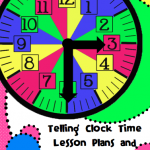
I just recently revisited one of my favorite lessons due to teacher request. I used to teach in a Title I school last year, but now teach in a more affluent area. I found myself teaching differently with the new set of students. Still, this lesson is one of my favorites, and helped 100% of students answer one of our practice standardized test questions (we are taking the ACT Aspire this year). First, I copy clocks on three different colors of paper for the students. Students get 3 different colored clocks each.
I pose questions to get the students to think about how we would cut the clocks into halves, fourths, and thirds. I found with the new group of students they had more intuition to think about how to divide the clock–reasoning about a clock face containing 60 minutes. Next, I questioned them about how we could divide the clocks into halves. This was easy for students. They knew we could split the clock into 30 minutes for each half.
Because halves relate well to fourths, through discussion I had students break their next clock into fourths. Sometimes there is a misconception when students break a clock into quarters or fourths because there are four quarters in a dollar. Students want to start their sections dividing on the four. This didn’t happen in this case however. Students knew that they could split the circle on the 3, 6, 9, and 12.
Next, I had students divide a clock to make thirds. This is always more of a challenge to students because thirds are not multiples of twos. I allow students to have a little group discussion at this point among themselves because they are unsure of how to divide the clock into thirds. When I remind them that the clock face contains 60 minutes, suddenly, they realize that they can divide the 60 minutes on the clock face into three parts on the clock face into equal 20 minute sections. Some also realize that they can take the 12 numbers and divide them into 3 equal parts which places four number sections in each part. The kids say, “Oh! It’s like a peace sign!”

From here, I have students do a worksheet which asks them questions about fractional parts of a clock. For example, what is 2/4 of an hour? ¾ of an hour? ⅔? And we explore how the size of the whole affects the size of the fraction when times smaller than a whole are used. Read here if you want to know more about this lesson.
If you want materials for this lesson, go here:


Know Your 5s Facts by Doing This…
So recently I discovered that the 6s multiplication facts multiplied by an even factor have a repeating pattern in the tens place. This made me rethink the 5s multiplication facts. Could there be patterns there, too? Here are the 5s multiplied by even numbers. Well, tell me what you think. 
I see that the facts all end in zeros and the tens place is half of one of the factors. Is there anything else?
Here are the 5s multiplied by odd factors.
Now for students who count on their fingers for their 5s this is another tool that could help them arrive at the answer faster than counting by 5s on their fingers.

I notice that the 5s multiplied by odd factors always have a 5 in the ones place. Now is there a way you could describe the pattern in the tens place? Hmmmmm….I don’t know. What do you think? Do you have any strategies for making 5s easier for kids to learn?
And finally, here is a question you could pose to children. How can knowing your tens facts help you learn your 5s facts?
How to Intervene with Children Who Don’t Know Their Addition Facts
I have worked with children from 2nd grade on up to help them learn their addition facts. One common denominator exists among all of these students. That is THEY DON”T SEE PATTERNS! I remember having a difficult time learning my 9’s facts when I was growing up. To help myself, I just took one off of the number I was adding to 9 in the ones place. I noticed this pattern. No one taught me this. When I was growing up, learning facts was like, “Ok, Class, let’s learn all our 8s facts, let’s learn all our 6s facts and so on.” This is not effective for students who don’t recognize patterns on their own. Now with the common core mathematical practices, we should be teaching children to explore patterns through thoughtful placement of number facts to help them recognize these patterns. Giving students opportunities to see the patterns will result in more students who are fluent in their facts. I have shown examples of this before such as in this post about using 10s to help with adding 9s.

But now I have actually put all of my work with struggling learners into a packet which could be used whole group for grades 1 or 2. At the 3-5 level this could be used for students in intervention or as part of the RTI process. Here is a look at the packet that I have put together to help students become fluent with all of their addition math facts. It is on TPT !


You can also try out a little sample of this product for FREE here.
Need a Thoughtful Inexpensive Teacher Gift?
For Christmas I wanted something thoughtful, yet inexpensive to give to a few of my close coworkers. Since I have been learning about essential oils, I recently attended a make-and-take party at which we made sugar scrub. As a result, I decided to make sugar scrubs for my co-workers and decided to even take a scrub to a retirement party I am soon to attend. For the retirement party, I put a label on the lid that says “Reti
rement is Sweet”. Here is the one I am taking to the retirement party…
 Now the cute “handmade just for you” labels I found ready made at one of my favorite places–Hobby Lobby. I made the sugar scrub labels/directions and you can download them here if you like. They don’t really show in the above picture but they are behind the “handmade just for you” tag.
After considering many different recipes, I didn’t like the dryer feel of using a tablespoon of coconut oil so I made mine with almond oil.
Recipe:
Make sure you have two different bowls. You will want a smaller one for the oil and a larger one for the sugar. Use any combination of white and brown sugar you want. I chose white sugar because I didn’t want to overwhelm the smell of the essential oils. Brown sugar tends to do this.
I used 8oz. sized mason jars.
In the oil bowl:
I put ¼ cup of almond oil (available at health food stores such as whole foods).
5-8 drops of essential oils of your choice.
a few drops of Vitamin E oil
Stir the oil ingredients slowly in the oil bowl.
In the sugar bowl:
I put ¾ cup of sugar.
I slowly poured the oil into the sugar bowl and mixed with a fork until the oil was absorbed by the sugar little by little.
To complete, I spooned the sugar scrub mixture into the mason jar. You can cut out pretty scrapbook paper to place underneath the ring of the mason jar. To get a perfect circle just trace the flat circular lid. Then attached pretty ribbon and the tags.
Are Your Students Adding and Subtracting 10?
Are you teaching your firsties to add ten, subtract ten, add 1 and subtract 1? The week before Christmas we added this game to one of the selections in the students’ math stations. This game is called “Bubble Gum Pop”. The kids absolutely LOVE it!!! 
Students move “bubble gum balls” (bingo chips) up and down the 100’s chart mat according to the spinner. The game is differentiated for students who need more of a challenge so that they can use a mat that counts to numbers past 100 or they can use a bubble gum spinner that allows them to even add or subtract multiples of up to 20.
 In this photo above, students are tied with both having an equal number of chips on the board. The one who knocks the other student’s chips off the board first is the winner. What makes this game fun is that there is an element of chance when students land on the pictures, their chips are out. Also, the game requires children to know which direction to move on the board to add or subtract 10s and 1’s so they are learning at the same time.
 The game is also available in color. I copied it in second grade however on colored paper, but ended up liking the black and white better because I felt the students could see the chips and numbers better on the board. The color definitely did make the game happier though.
Don’t Do This When Teaching Graphs
To enjoy the week before Christmas break, I decided to try out a lesson idea I had about pictographs. I built this lesson around misconceptions that students always have about keys with numbers larger than one. The day before I taught this lesson, I was asked to teach math at a moment’s notice in another third grade class. When this third grade class interpreted a pictograph with a key of four, I noticed that this was really way too easy for these smart students. I decided to change my planned lesson idea into something more challenging. This is how the lesson went…
First, I did a quick lesson for understanding. I surveyed the class about their favorite ice cream: vanilla, chocolate, or strawberry. I then made a frequency table with this information on the board. With some yellow circle die-cuts with one circle to represent two children’s votes, I asked the class how many votes needed to stand for each flavor. Students did this very well even if this required half of a circle for one person. Then I had each flavor group stand in a different area of the room and I passed out the number of circles the children told me to each group. When I passed out the circles to each group and instructed the students to write their name on a circle, some disequilibrium arose. Students said they didn’t get a circle. I told them to talk to their group and they finally understood that they would need two names on each circle. I couldn’t have been more proud of this part of the lesson and the mathematical practices that arose from their discussion. Then came the next part of the lesson…

I previously gathered real life data about students’ favorite Christmas candy.
- I chose four types of candy: fudge, candy canes, M&M’s, and chocolate Santa’s. I gave three third grade classes each a roll list with a blank beside it for the students to write their favorite candy on. I collected these vote (data) sheets right before the lesson (mistake #1 don’t do this). I made six copies of the data sheets for each of the groups.
- In the lesson I presented the children with the data and told them to create a tally chart/frequency table with the data. Students waded through this for a long time without consistent results. I should have counted the data before I passed it out even though I had estimated the results to around a total of 66 students. I ended up having to total it up while the students were counting (mistake #2 don’t do this). Have your data counted before you pass it out, so you know when your students are way off. (But, hey, in my defense, I have been pulled in all directions lately, substitute, fill in secretary, test coordinator, you name it.)
- I made one student in each group of four responsible to count each class’s data since there were three classes and one student to record the data on a table. This worked very well to keep every child involved in the group.
- We stopped the lesson to ensure the children had the correct data before we proceeded with graphing. I wanted to be respectful of the teacher’s time while I was in her room, but I may have had them check to see if their data was correct in a different way, such as, compare your data with a different group and see if you agree before I just revealed the correct answers.

Next, I told students their key had to be 5 or more (I really had 6 in mind), but the teacher was concerned that it wouldn’t come out evenly for the students. The data had to be slightly altered for the die-cut circles to come out with wholes and halves. She didn’t want the students to have to deal with smaller fractional parts. I was actually okay with the students having the data not come out evenly because I wanted this to be a challenge for them to grapple with. In the real world, data doesn’t come out all nice and clean. Third graders had already proven themselves with a key of four, and I felt like they needed a challenge. I wanted them to discuss how much of a circle to cut apart. Again, I wanted to be respectful of this teacher’s time, so I allowed this and the students’ graphs all turned out pretty much perfectly. No fun :/ There was no argument over how much of a circle to cut apart. (mistake #3, don’t make your data work out perfectly). Needless to say here, I had many reflections after this lesson. This was definitely not my best moment as a math coach (I am at a new school this year). BUUUUUT!!! I loved this lesson, it was so great, even though it wasn’t! I know exactly what to do next time to make it better, and it would be an exceptional lesson with lots of mathematical practices involved! Next steps for students after this lesson–ask students what would have happened if the key was 5 or 6 to at least get them to think about this.

Cyber Smile Monday and Tuesday Sale November 30-December 1!
Don’t miss out on this Cyber Monday and bonus Tuesday Sale!!! All items in my store will be 28% off!
Happy Thanksgiving to You and Yours!
I wish you a very Happy Thanksgiving with your loved ones! I want you all to know, followers, that I am thankful for you!