






5 Days of Work Later…
My room is starting to come together after throwing away lots of stuff and moving some things into storage, I have more space! Everything is all dusted off! As you can see I have graduated from the enormous trashcan to my normal one. My trashcan went MIA at the end of last year…mysteriously the custodian found me another one. As you can see my normal trashcan runneth over. Surely cleanliness and organization will follow me all the days of my 13-14 school year!

Hmmm…I still need something for all that ugly white space on the walls…I think I will wait on covering it. I may make some charts with our teachers during a planning session to hang up there.
Coming soon…you will get to see a picture of my creative math door!!! You’re going to love it!!! I’m so excited about putting it together, but I must focus on what’s important first–getting ready for my PD presentation on Wednesday! :/
If I could have a frivolous full time job, it would be bulletin board and door decorating extraordinaire! Any takers? 🙂
Day 1 Monday…Going Home Covered in Dust!
Here is a look at what I came back to Monday–my little room piled to the ceiling.

Dusty Day 1 and I’m back!

As you can see I am the goddess of math manipulatives. The secretary says if I get any more math tools that you won’t be able to find me!
Before I came to school, I had all these cleaning ambitions, but when I left 6 hours later all I could boast about was this one shelf that I cleaned out. I guess the custodian thought I looked like I needed the WHOLE trashcan cause he brought me one and 3 additional trash bags! I threw away notebooks that I had saved from 4 years ago…you know “just in case” I might need them for something! I finally decided that if I hadn’t used it in all those years, that I wasn’t going to.
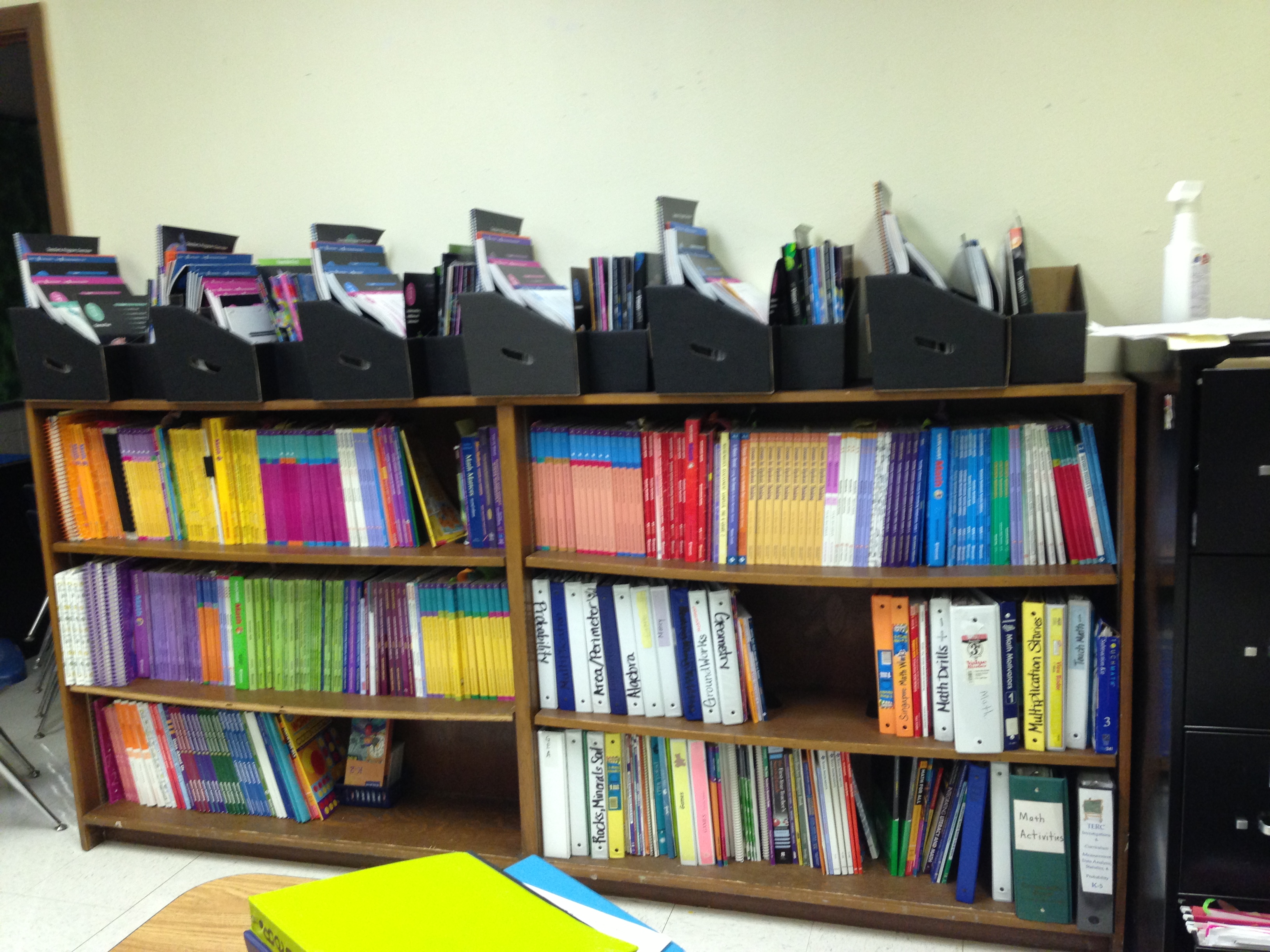
- Ta-da! All color coordinated and everything!
How Can You Make a Life Sized Hundred’s Chart Cheaply?
At the last NCTM conference, I went to a session about “The Learning Carpet” which is a giant 10×10 grid. This life size grid helps students see number patterns on a 100’s chart. To actually buy one it costs around $300. The presenter told us that she started out with a tarp to make hers before she had the carpets manufactured. Intrigued with the multiple ways the carpet could be used, we set out to teach people about the carpet in our own district and make our own. Several of us made them with small patterned duct tape. They took us about 3 hours to make, and it works best if you have help. Each square is 6 1/2 inches wide. On the real “Learning Carpet” the lines in the middle of the squares are 1/2 inch wide, but the duct tape we used is over an inch wide. There are number and letter cards that go with the mat which we made as well on card stock. One of our teachers took the initiative to get together before school started to make the “learning tarps” so we could help each other. To buy the tarp and duct tape it costed us about $30. Which is the better buy? Hmmmm…you do the math! Below are our results.
Turquoise and pink chevrons…wooo!

Yellow and paint splatters…

Orange and bubble design…
As you can see from this photo, it is easiest to lay all the horizontal stripes first and then go back and lay the vertical stripes.

I tried to make a learning carpet a different way just to see if it would work…my little experiment! I built a stencil from a piece of poster board and spray painted the stencil on a full size sheet. To make the stencil, I cut the 1/2 inch outlines away from the squares while leaving a little piece of poster board attached to the squares so that the stencil wouldn’t fall apart. The stencil is the green rectangle with paint on it that you see lying on the sheet.
I just moved the stencil and lined it up each time I spray painted to repeat the pattern. Towards the end I started getting several smudges since the stencil was getting soaked with paint. Sturdier cardboard may have worked out better. Two cans of spray paint are necessary to paint all the squares on the sheet. The total cost for the poster board, the sheet, and the spray paint was about $20. Although the spray paint/sheet method was messier, it is much easier to create this project alone than stretching the tape exactly straight with the tarp method. Plus you can easily throw the sheet in the washer when it accumulates too much kid dirt!
A few paint fumes later…my finished product!

If you truly wanted to have a learning carpet, this stencil method would work to spray paint a carpet remnant with low pile as well.
Read my original post about “The Learning Carpet” to find out more about how this can be used in your classroom.
I Met My New Favorite Math Hero!!!
I just came back from the SDE conference in Chicago this week and I got to see some famous teachers on my trip. I met three famous TPT bloggers and one author. I found it so fun to see what the bloggers’ personalities are like behind their pictures. I saw Cara Carroll from the First Grade Parade who had a very good session about fun math activities you can do in your classroom and how to organize math centers. She is very high energy, bouncy, witty, and fun. Her loud personality transforms an entire room.
Then I saw Abby Mullins from the The Inspired Apple. Her personality is sweet and precious. I was so impressed with her attention to detail as she gave all of us in her session a pack of sticky notes, an adorable business card, and the most precious apple cookies that her mother made! So cute! Her presentation was adorable as well with beautiful backgrounds. Everything she touches seems to be as cute and creative as she is. I really enjoyed her ideas about how to preview a book and label ideas with different colored sticky notes before you write a lesson plan. For example, use blue stickies to write numeracy ideas down or green to write hands on learning ideas to help incorporate math or science etc. into your lessons.

It crumbled a little in my bag, but the cookie was still yummy.

I love this adorable business card!
And who could leave out Erin Klein from Kleinspiration. I actually was on the elevator twice with her all alone. I did say, ” Oh! I recognize you from your blog.” That is as far as I got. I was too shy to tell her I blogged too. She seems so smart and has like eleventy billion followers, and I guess I was thinking I’m like a small gnat in the blogosphere? Erin seems just like her picture too…sweet and smart! Anyway Erin’s session was so inspiring! I learned about flipped learning where you video yourself teaching the lesson and have an extra self to help kids stay on task. I love the idea of having a cloned self!! She also demonstrated all kinds of cool tech gadgets like the Live Scribe Pen that records whatever you say when you write and Sifteo Cubes like digital legos.
Now for MY NEW MATH HERO…(long pause with bated breath)…so exciting…I must say it one more time….SO EXCITING! Here’s a clue…

You guessed it! I met Greg Tang, got my picture made with him, and he even autographed my Grapes of Math book! See!

I’ve always admired his books…remember my door decorated with the Grapes of Math?
Greg (yes, we’re on a first name basis *wink*) challenged my thinking for sure! Greg doesn’t come from the school system educational world and is not a “teacher” although he has worked with kids at schools on many occasions. He is SO smart…a Harvard graduate with a common sense education perspective and hilarious dry humor. He takes VERY few rabbit trails in his presentations and is a very no nonsense kind of guy. Greg says that if a task is daunting, break it apart into chunks to make the task smaller. With everything in life this principal works. He says that we make math too difficult (agreed). Again he says that kids learn math when they learn patterns…so true! We as teachers don’t show them enough patterns so that students see all the connections among different math concepts. My favorite part of Greg’s presentation is when he showed us how regrouping relates to all the measurement concepts…not just adding/subtracting.

If you have the opportunity to hear him, make sure you take it! You will learn mountains and your thinking will be changed!
Oh, in case you don’t know, all of his books are animated on his website, AND all of his worksheets and games are free on there too!
Like I said…my new math hero!
Use This Amazing Cleaner When You’re Cleaning Your Room!
I recently had a sticky mess all over my front door’s glass which I admittedly created. See, my front door’s glass has these pretty damask rose cut outs in it, but if I were to walk by in say a towel or less after just getting out of the shower, you can see right through the door’s glass where it isn’t frosted. Eeeeek! So, I spent $17.49 with a coupon to purchase this sticky frosted film to add some privacy to the door. About two hours later, I had stickiness on every finger, on the door, and my hair even got stuck to the stuff. My dog was just laying there looking at me like, “When are you going to give up?” Disgusted with myself, I went to the grocery store to find some Goo Gone which my mom swears by…listen to your momma! The Goo Gone got every bit of the sticky mess off of the door. I couldn’t stop saying “Wow” while I was cleaning with it because it worked so well. When you rub it on with a paper towel, it takes the stickiness out of the residue. Then you go back over the residue with a wet soapy paper towel and the sticky stuff balls right up and comes off. Ta-Da!
While I was cleaning with it I was thinking how great Goo Gone would be great for cleaning off all kinds of sticky messes that are made from things you put up all around your classroom…especially the sticky residue left by attaching name tags to student desks.
Happy back to school cleaning when the time comes!
4 Teacher Discounts You Don’t Want to Miss for Back to School 2013…
- Office Depot will be hosting their annual teacher breakfast and teacher tote bag with goodies giveaway in my area August 3rd. You will also receive 10% off your purchases. To find out when this event will be held at your local Office Depot, click here.
- Staples will also be hosting their back to school teacher appreciation event on August 3rd in my area (Arkansas). Their event isn’t quite as compelling as Office Depot’s in my opinion. They are offering a free tote bag and 20% in Staples Rewards off the items that you can fit in the bag to the first 100 teachers. Also, you have a chance to win a $25 gift card. The teacher event is only for a few hours so make sure you check the hours. To find out when their event is held in your area, check Staples’ site here. Don’t worry I won’t knock you down at the door for a tote bag! I will likely be enjoying a donut at Office Depot!
- Mardel Christian and Education Supply will be hosting a 20% off event on July 18th 8a.m.-10 p.m on all education, home school, and kid supplies as I was told when I called. The man said that this should be at all locations, but I cannot find this on their website. Here is a link to their locations page if you want to call to be sure this is the same in your area.
- Office Max- I wish I had one of these in my area. Their website is designed for ease of finding discounts for teachers. They will be giving away a tote bag and having a 25% off sale for teachers. They will also be giving out coupons. It appears that their event will be for a 3 day weekend. In a couple of the southern regions, their sale will be on July 20th-22nd. Check the website here to find out when the event will be held in your area. Be sure to check out their teacher’s corner deals too.
Congratulations to the Winner!
Congratulations to Dawn Thompson of Florida! You won the Magster Magnetic Ceiling Hooks! These will come in very handy as you start your first year of teaching! Best wishes to you in your first year!
Is Your State Having a Sales Tax Holiday?
To see if your state is having a sales tax holiday, check this list. The list will give you the link to your state’s tax free holidays if your state participates! Many states are having a back to school tax free holiday the weekend of August 3rd. Save yourself a few bucks!
How Can Short (or tall) Teachers Hang Items with Ease in Their Classrooms?
I have done everything in the past to hang items from the ceiling at school. I’ve climbed on tables and chairs, borrowed tall people, and sweet talked the custodian with a candy bar. Hanging items from the ceiling is something that I always dread doing since it takes so much effort. Now I don’t have to borrow my custodian or climb like a monkey because of these new hooks I ‘ve found–Magster ceiling hooks. Magster ceiling hooks have a convenient pole that I can use to attach magnetic hooks to the metal part of the ceiling. I just lift the pole to the ceiling until the magnet attaches. They are easily moveable and can be taken down with the same pole. Now I am just thinking of things to hang up for next year.
Here is what came in my starter package:

Above the wood sticks join with the black pieces to make a long pole. The U-shaped black piece holds the hook. The other white plastic items are the hooks.

Above you can see how the wood pieces join to make the pole to hang the hooks.

Here is me standing on the floor (not on a chair, not on a table) with my 5 ‘ 3″ self and hanging a hook.

Ta Da! That was easy and quick!

I can even use this to hold my posters…See!

The pole makes it super easy even to hang posters above! (I hate that my ceiling is cracked right there. They won’t fix it though 🙁 )
Surprise! I’m hosting a give away of one package of these wonderful hooks which you will absolutely LOVE! All you have to do is make a meaningful comment on any post on my blog, and leave another comment below about what you would hang if you won the new hooks. The contest will close on July 10th. I will select two winners at random and announce them on July 12th!
One More Fabulous Free Common Core Resource!!!
I will start out with my most favorite state’s common core resources that I have seen so far. This one ranks up there with the depth of the Georgia State Units. Not to keep you in suspense, but North Carolina has done a superb amount of work on these units. Each one has lessons and student tasks ready made to go with each lesson. These units are not ALL conclusive though. There are some holes or standards left out, but what is there is excellent quality work! Thank you North Carolina!
First you will come to this page. Click on the grade level of your choice.

Then you will be taken to this screen below. There are many resources here including the unpacked CCSS. To find the unit lessons click where the yellow arrow is, but the other resources are definitely worth exploring as they will give you an overview of the unit, parent/school connections etc.

When you click on the unit link, you will be taken to the cover page of the unit that looks like the following.

Then when you look inside the unit, you will see complete lessons….

…with tasks and or recording sheets included…

I hope these save you time from recreating the wheel :).