





Has the Weather Put a Damper on Recess? Measure Instead…
One day the students had been inside for days, and not been allowed to play outside because it was so cold. Wanting the students to enjoy the slight snowfall we had just had, I called the office to let them know we were going outside to do some measurements. This was my way of giving the kids a little outdoor time! We measured the depth of the snow with rulers in both inches and centimeters.

We even calculated the temperature to see how cold it was…

Why can’t you take a little time out for fun and math with the weather?
Need a Fun Way to Introduce Area?
Kids love this! Find the area of the desktop in square units…or in this case in square sticky notes! Give students a sticky note pad and let them stick the notes all over the desk, leaving no spaces and without overlaps. Then have students count the number of sticky notes that it took to cover the desk. If there are some sticky notes hanging off, then you will be able to talk about the halves–or in the picture below thirds. Wow! A fraction lesson in the midst of an area lesson. Then students will be able to talk about how the halves fit together to make wholes or that 3 thirds makes a whole. Have students calculate the number of wholes plus their fractional amounts hanging off to find the total. This works as a lovely discussion of square units since the pieces that are counted are actually squares. One sticky note pad (of 100 sheets) will be enough to cover a large desk like the one shown below. If students have a smaller desk where the books slide in underneath the top, then half of a sticky note pad will be enough to cover one. If you prefer an alternate activity, try finding the area of a book with Cheeze-its, or Starburst candy squares–these unit squares don’t work well to discuss fractional pieces though.

Seize This Easy Opportunity for Students to Measure
I’m always trying to find ways to help kids learn math by osmosis :). I try to hang vocabulary words and other mathematical items in the hallway near the bathrooms to help kids learn while they are waiting in line. I even asked my principal a few years ago if I could hang a multiplication fact on the back of each bathroom stall door. I thought they could learn a fact while they were sitting there on the, you know, toilet :). My principal unfortunately didn’t like the idea. She thought the kids would write on them. This is one of those times when I wished I would have asked for forgiveness rather than permission! Now onto the easy measurement experience for kids.
The fun measurement activity started with my mom. (I must take a moment and tell how thoughtful my mom is! I love her! :)) I really appreciate how my mom supports my teaching and blogging efforts. She is always sending me items to use for school. This time she sent me this growth chart she had gotten from somewhere. I laminated and hung it up near the restrooms so that students could measure themselves in inches. After it had been hung up a while, I realized that many of the students in the 2nd-4th grade hallway were too tall for the chart so later on I hung up a measuring tape beside it which goes to 60 inches. The teachers in the hallway are always telling me that kids love to measure themselves. Many of them measure themselves from week to week to see if they have grown from one week to the next. I hung a sign above the measuring chart that asks students how tall they would be in feet and inches. Later on, I added the arrows that show how many feet every 12 inches are worth. That way a student will at least be a good estimator to five feet or 60 inches. Below are pictured the measuring tape and the sign that are hung outside the bathroom. I know you may be thinking that kids will waste time instead of coming back to class…but on the contrary the students that are measuring themselves are actually having a meaningful hands-on learning experience even if it does take an extra minute.


Use This Simple Idea to Help Students Understand Fractions of an Inch
Because rulers have so many small lines, they are difficult for students to understand and differentiate. Because of this struggle, I took a flat ruler and placed it on the copy machine and blew it up until an inch section was about as large as the page like below.

Then I cut off the centimeter section and the marks after the one inch mark.
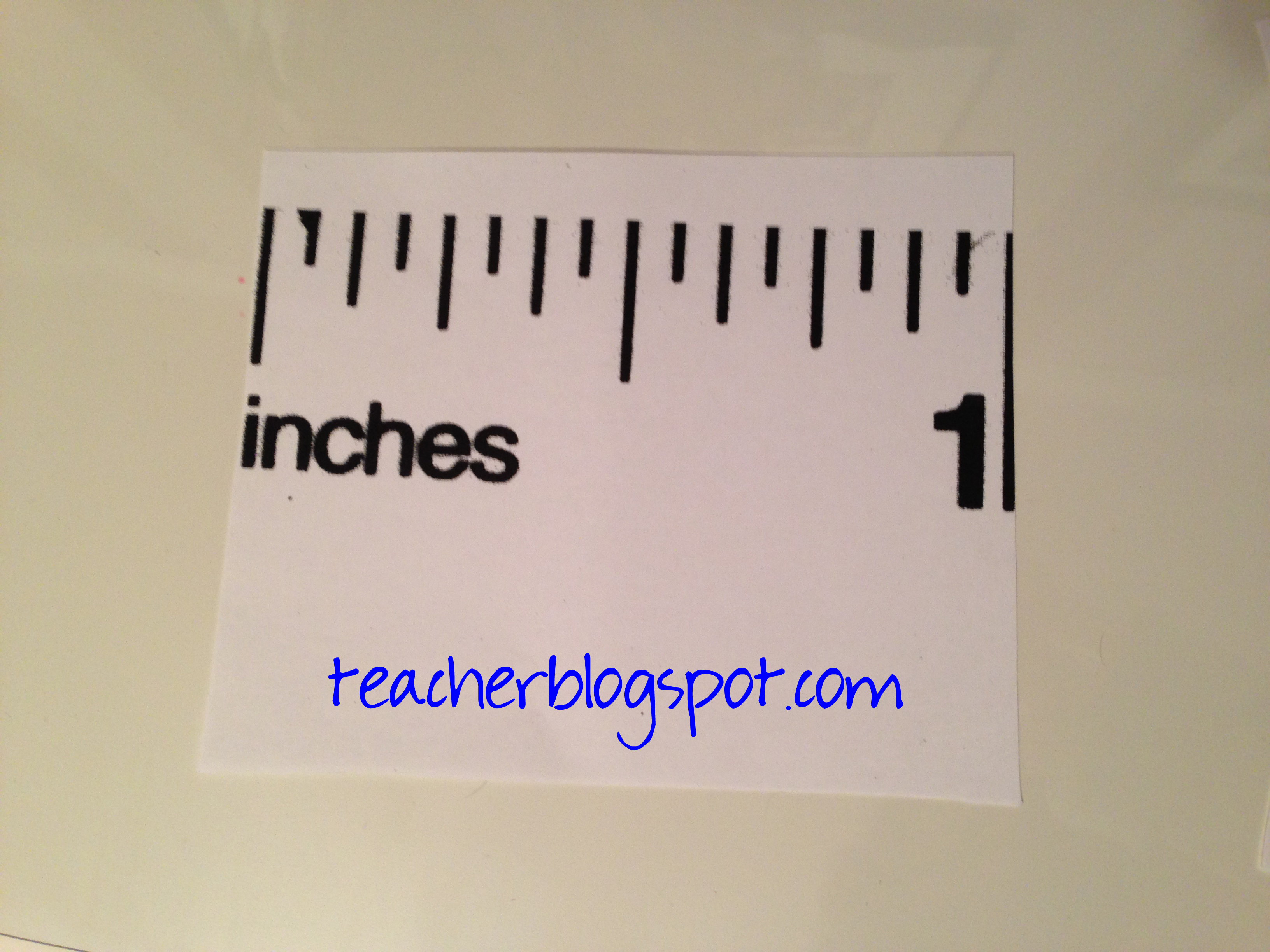
Because linear measurement is more difficult for students to conceptualize, I relate it to parts of a whole by using this enlarged ruler. Now that I have trimmed all of the sections off, students can see it as 1 WHOLE rectangular section as opposed to the daunting linear ruler. I have students fold the ruler section into half along the half inch line. When we study parts of a whole, we fold colored paper in half. This make the ruler like parts of a whole instead of a linear model, so the ruler marks are easier for students to understand.

Next, students label the half point on the ruler where the paper folded.

Then students fold the halves into half to make fourths and label the fourths. After labeling fourths, students begin to see equivalent fractions.
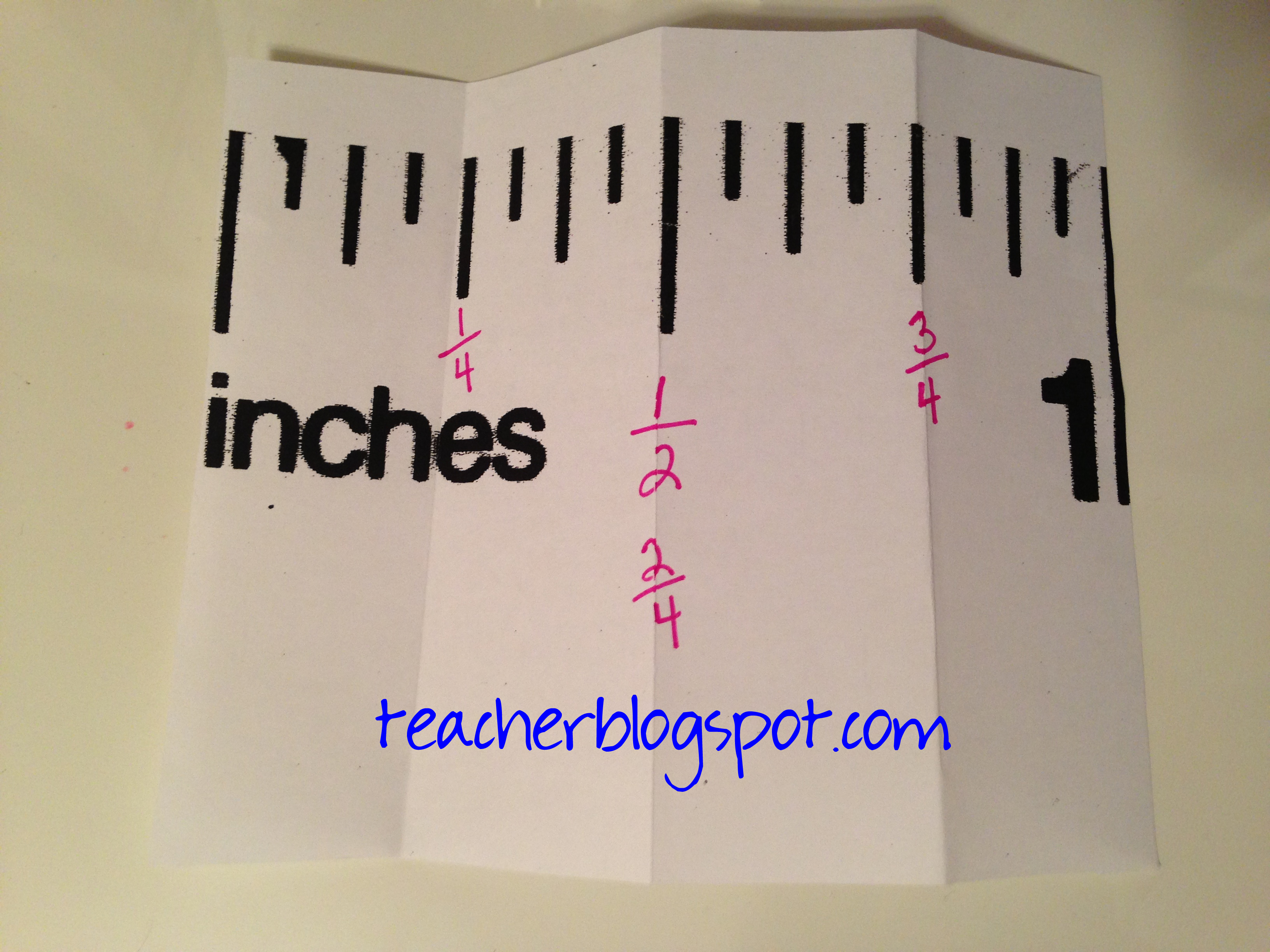
You could fold the fourths an additional time to make eighths also, but elementary students aren’t required to know eighths yet.

An additional fold would make sixteenths, but this is not really needed since all of the marks denote sixteenths. Now you and your students can pull this ruler out anytime you need to refer to the fractional measurements. The only thing to beware of is that students recognize this fractional pattern repeats for every inch. You will have to repeat the pattern for each number for students to recognize this. Another error that can occur is that students leave the whole number off of their measurement and only think that the fractional marks stand for fractions alone. Measuring to fractional inches greater than 1 and writing fractions greater than 1 need to be modeled. I hope this tidbit helps you and your students!
Edited 1/25/14: I just found this great free ruler picture that would be great to use for the above activity. You can see it here.
Heads Up! Linear Measurement Misconception!
While working with 5th graders today, I was reminded about the misconceptions they have when measuring with a ruler. Normally students are asked to measure to the nearest half or fourth of an inch. First of all, what does nearest really mean? We assume that 10 and 11 year old children know what nearest means…but do they? Our number one mistake as educators–especially new educators is that we assume students know the meaning of things they often do not…only as a reflective experienced teacher do we figure this out. (had to take that rabbit trail!) Back to measurement–once students are taught that nearest means closest we think we are in the clear, but, NOPE, we still have another problem. When you as the teacher say, “measure to the nearest half.” Students think that the only halves are the numbers that have halves written in them. For example, students think that the answer has to be 1/2, 1 1/2, 2 1/2, 3 1/2 and so on. They fail to bring their fraction understanding of wholes being two halves with them. Students can understand that measuring to the nearest half could mean the measurement might be a whole number (which is made up of halves) when they compare a linear ruler to wholes of a fraction like 2/2. This same misconception occurs when students are asked to measure to the nearest 1/4. Students think you are literally asking them to measure to only the nearest one-fourth. Even if a measurement is 2 inches, students will say that the measurement is 2 1/4 because they hear the phrase literally.
In the example below, students who have misconceptions measuring to the nearest 1/4 will, for example, say that this marker measures to be 5 1/4 because they are looking for the number 1/4 instead of the nearest 1/4 increment. In actuality, the marker measures to be 5 1/2 in., and students will only understand that this is the same as 2/4 through work with equivalent fractions. Please excuse the insurance advertisement on the ruler :/. This was the only ruler I had available at the time.

I will be posting more soon about teaching linear measurement :). Come back soon!
How Can You Incorporate Literacy with Coordinate Grids?
I was ecstatic when my new books arrived! I had been wanting to order these books for a while, and finally discovered that I had some money in the budget! What is so great about these books is that they tell the story of how Rene’ Descartes invented the coordinate plane. The general story tells of how he was sick in bed staring at a fly on the ceiling and wanted to map its location. As the old adage goes, “necessity is the mother of invention”, so Descartes visualized the coordinate grid system on his ceiling to locate the fly. This is such a great story to help students conceptualize coordinate grids while tying social studies (maps), literacy, and math together in one lesson!
Drumroll please……..
And the Tea-cher time giveaway winner is…(long three second suspenseful pause) Kimberly Malone!
Congratulations Kimberly! You will be receiving a wonderful package of specialty teas in the mail soon.
Readers, if you have a chance, read her great comment about fractions basketball here.
Teaching 3 Dimensional Solids?
Check the trash first! Whenever teaching dimensional solids, I look around the school building for large boxes that may be thrown out. Especially in the teacher workroom, there are always bulletin board paper boxes, toner boxes etc. that are being thrown away. This is where I have found some of the best trash for treasure pieces for my 3D solids collection. When I have found one, I wrapped it in colored bulletin board paper with the name on each one to help students have a constant visual of prism pieces. At the time I teach solids, I also have the students bring in items they find at home that may be prisms, cubes, spheres, or other solids. They relish sharing their found items with the class. When they share them with the class, they must ask the students how many faces, edges, and vertices there are. Students get extra credit for bringing in solids. The best solid that I ever had a student bring in was an almost perfect triangular pyramid made out of rock! Below are pictured my recycled trash 3D solids.

TEA-cher Time Giveaway!!
I am SO excited to be hosting a giveaway compliments of TRADITIONAL MEDICINALS® teas. They have a wonderful array of teas which are healthy and delicious. My favorite flavor is peppermint. Pictured below is the product sample package that they will be sending the lucky winner. I was so surprised when I received this in the mail because the sample was so nicely packaged. There is a ceramic mug (made in the USA I might add) three boxes of teas, a tote bag, and a tea sampler with different types of teas arranged ever so neatly in a wooden box. The teas all come packaged with descriptions of their health benefits.

I will be choosing one winner at random who comments below on the following prompt. Only U.S. residents may apply. The contest will be open until next Saturday at 11:59 p.m. CST.
Since spring is approaching, comment below about your favorite most creative math lesson or activity for spring. If you don’t do anything special for the season of spring, just tell us about your favorite math lesson.