





How Can You Reach Parents During Family Night?
When looking for items to place at a table during family night for parents, I stumbled across some great info already made on a website. I took this info, and copied and pasted it into Microsoft Word with some cute fonts and borders. I would offer you my final product here, but I would be infringing on copyright. I will give you the links I used instead.
Ideas to Help Your Child Succeed and Enjoy Mathematics
Why Math Looks Different to Parents than When They Grew Up
And there is even a power point that you can play for parents–ready made!

See isn’t this great!
Do You Need an Idea for Family Math Night?
As promised, here are a few snapshots of our Family Math Event/100th Day of School Celebration!
Students built number bonds with Legos, and got to take a few Legos home!


Students built 10 groups of 10 to make 100 with different small food items. This was one of kids’ favorites since food was involved!

As you can see in the picture above, this is one of the staff members that dressed up like she was 100 years old. She said she got her whole outfit at Good Will for $4 with the exception of her wig from Party City.

Students played Race to 100 on the 100’s chart with dice. They rolled and added the number that they rolled each time on their 100’s chart.


Double dice subtraction is a game idea taken from the Georgia Department of Education resources.


How creative! This teacher made a multiplication/division edition of chutes and ladders complete with spinner. Kids loved this activity.


Kids flocked to this booth where they made chocolate chip cookie dough. Students mixed up the dough in a gallon baggie to prevent mess. The math was in the measuring cups fractions. They had to figure out how many small measuring cups to use in lieu of the larger cup sizes. For example, if the recipe calls for a cup and a half of flour, how many times will you have to fill a 1/4 measuring cup?


We can’t forget the Estimation Station! The closest guesser got to go home with the jar including candy! We gave away five jars.

One of my personal favorites…maybe because it was my idea ;), is the 100 scavenger hunt. Students had to find index cards hidden around the cafeteria. Each card had an equation, but only some of the equations equaled 100. If the equation made 100, students could then bring it to the scavenger hunt booth for a prize.

Students used different fruits and vegetables to equal up to a pound in this next picture after first estimating.

At the probability booth students used fractions to predict the chances of landing on a variety of spinners. Students got to take home their own spinners.

We also had a technology table where students got to play math games on our schools mini laptops.

Moe’s Southwest grill kindly donated tortilla chips for us to have nachos! And, the church next door to our school kindly donated lemonade! We also got plastic sacks donated to us from a nearby restaurant so that students had a bag in which to place all of their take home math activities.

The kids went home with smiles!
A Few of the Best 100 Days of School Dress Up Costumes!
The following are some of the best 100 days of school dress up that we had. We incorporated our Math Family Night with our Students’ 100th day of School Celebration. I sent this letter that I used last year to inform parents of the day’s dress up celebration. Again I used a rubric I adapted from Ms. Saoud’s blog at Primary Graffiti here.
Which costume do you like best?
Which child’s costume do you think won?
I’ll tell you at the end of the post! 🙂


My favorites are the “Name Your Own Star” –how clever…and the wrestlers belt–how creative! I also especially like the student in the school uniform with the notes safety pinned to her because it looks very kid done! Each note has a different word on it.
Here is my favorite staff dress up outfit. 
We also had a couple of staff members who dressed up like they were a hundred years old. They had walkers and all! One of our staff members had a sign on her front that said I am 100 years old. On her back she had a question that asked, “When was I born?” The kids had to bring her the answer written on a piece of paper.
I have a thing for puffballs, so I used 100 puffballs to make a scarf of sorts. It didn’t quite turn out like I had wanted. I used hot glue, so it was a bit stiff. I glued all the puffballs to a ribbon. Maybe if I was more of a seamstress it could have been a real scarf! Nevertheless the kids loved the scarf and wanted to touch the puffs. I gave the scarf away to one of the kids who asked me if he could have it at the end of the day.  I guess you get to see my totally cute new phone cover in the picture, too! What an added perk! 🙂
To answer your question if you were wondering which child won from above, the first picture won of the little girl in the red shirt with all of the beads hanging down from safety pins.
Coming Soon This Weekend…All My Family Math Night Events!!!
Be watching this weekend for lots of pictures of the fun…..
My Favorite Fraction Tools
I wanted to share with you these new tools that I ordered for this year. I knew that we would be studying a lot of fractions, and we only had the linear models for a class set. Normally, when introducing fractions I start out with whole sheets of colored paper and have students cut them apart into halves, thirds, fourths, and so on. Then students can lay these pieces of paper on each other to find equivalent fractions. While this has value for students understanding that fractions are parts of a whole (piece of paper), students tend not to cut them out perfectly, so their equivalence investigation is a bit skewed. Because of this I move to manipulatives for the equivalence investigation, but again, I only had tools that were linear models…so here is what I ordered… Foamy fraction squares!

What is even better than the fact that they are brightly colored and quiet?

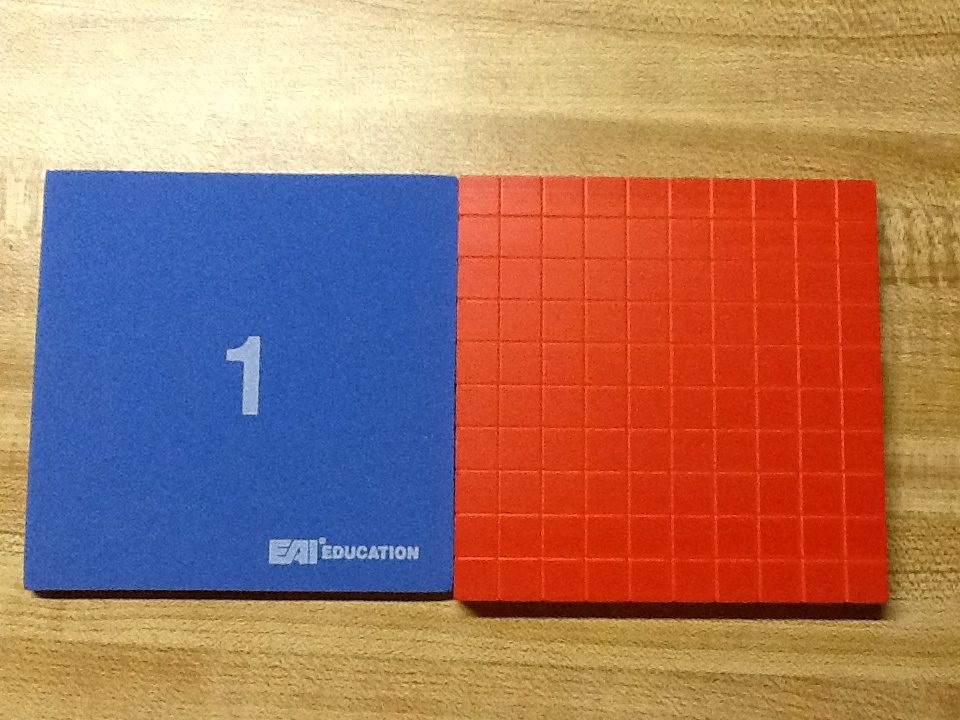
They are exactly the same size as a base ten block! This makes teaching decimal equivalents so much easier! I know the shadow makes the base ten block look larger but, they really are the same size.
See!

Students can easily see that one-half equals five-tenths, one-fifth equals two tenths, and one tenth equals ten hundredths.

I ordered a class set of these from EAI education here. I promise I make no money from telling you about these, but they make teaching fractions so much easier. Every teacher who has used them loves them!
Have You Ever Thought to Use These in Preparation for Coin Counting?

Do you know how they have those clearance buggies near the checkout at Wal-mart? Well, I just happened across these poker chips yesterday, and I got them for…get this…50 cents! YAY! When I saw them, they immediately reminded me of the money activities I created, and how I prepare students to count coin values first before adding real coins. Look how similar they look to the money sheet from my unit below. The only thing is that there aren’t chips that would resemble pennies, but I am still going to use these next time for their manipulative factor. Students can practice adding on 5’s and 10’s to 25’s. If you would like a free sample of the page below from my money activities, just click the download preview button on TPT!
Could This Be the Reason Students Confuse Many Word Problems?
After years of seeing students mix up math operations in word problems, I have finally figured out how to help students understand what operation to use in word problems. This little word is causing students much of the confusion–EACH. Haven’t we all taken for granted that students understand what this word means. The word ‘each’ is in nearly every multiplication and division problem, but many students don’t know what it means–every one in the group. If we teach students to read a word problem and replace the word each with its meaning, every one in the group, students somehow have a light bulb experience.
In conjunction with teaching students to understand the word each, also asking them questions about the problem helps facilitate understanding. For example when you ask, “Is this a joining or a separating situation,” students start to make sense of word problems. Students generally understand that words like altogether and in all mean that they are joining groups. The word total may need to be taught as a word that means in all, but total isn’t a difficult term for students to become comfortable with.
To help students further differentiate between multiplication and addition, ask questions like: are we adding the same amount over and over or are we adding two different sized groups? If the answer is adding the same amount over and over, then multiplication is repeated addition of equal sized groups. If students are confusing division and subtraction, ask, “are we subtracting different amounts or are we subtracting the same sized amounts over and over. If the answer is subtracting the same amounts over and over, then teach students that division is repeated subtraction of equal groups.

Family Math Night…I’ll keep you posted!
I’m planning for another Family Math Night. This time since the 100th day of school is the day after math night. Because of this, I am incorporating our 100th day celebration along with Family Math Night. I’m thinking about doing some fun things like…maybe a 100 scavenger hunt. I am going to hide signs around the cafeteria which are equations that equal 100. The catch is that some of them won’t equal 100. Students who find the equations that equal 100 will get a prize. I’ll keep you updated and be sure to post some pictures of all of the activities and ideas I have as they come to fruition!
Do your students know what a group is? or what a group of ten is?

I’ve been wanting to incorporate counting collections at school for a while, but I haven’t had the understanding of how to organize counting collections effectively. I recently attended a colleague visit where a kindergarten teacher showed the procedures she used for teaching counting collections. So, after attending this training, I initiated counting collections at our school with the 1st and kindergarten teachers. In the meantime, one of the kindergarten teachers shared with me at school that she realized her students didn’t know what a group was– much less know what a group of ten was. She began her instruction with just discussing groups and what kinds of things can come in groups. They talked about groups of three, four, or six etc. They made groups of different amounts in whole group discussion under the document camera. Students were able to have a foundation to understand a “group of ten.” Then the teacher was able to place a different amount of counters underneath the camera to ask if she had a group of ten. First, she placed less counters under the camera like 8 and asked if she had a group of ten. After that she placed more counters under the camera, like a group of ten and 3 more, and asked if she had a group of ten. Doing all of these seemingly common sense-ical counting procedures before hand led to a much more successful counting collections lesson for students to count their collections effectively. These are the rudimentary things that no college or textbook teaches you!
To read the valuable counting collections article from Teaching Children Mathematics, click here.
How to Set Up Your Data Wall?
I know when I was faced with the challenge of setting up a data wall, I didn’t really like the way I had it set up the first two years. Since then I have developed this idea which I borrowed from the middle school teachers at a school nearby. They used large pocket charts for each grade level and they colored students names with highlighters to indicate students’ proficiency levels. Then they used different stickers to indicate other factors such as special ed, after school tutoring, etc. While I really liked the middle school teachers’ idea, I didn’t like the fact that the student names were showing on the outside, which didn’t give the students privacy of test scores.

Sticker key to mark different student factors on each student data card.
Using the middle school teachers’ idea, I revamped their data wall for our school’s math wall. I used colored index cards to indicate proficiency level. That way we could identify students’ initial proficiency levels on the card, and they would quickly pop to the eye when they were moving up or down the wall. The only writing that faces the outside of the wall is the quarterly test data, and no students’ names. So, for example, when the pink cards (proficient students) move down after a quarterly assessment to the basic level, we can easily see that these students need intervention to move back up to proficiency. We different use stickers to mark students with special factors such as students who go to school sponsored tutoring. That way at the end of the year, we can determine if after school tutoring was effective by looking at students who score proficient at the end of the year state tests.

Data Wall Pocket Chart for 4th grade at the beginning of the year. (sorry about the cardboard box)

The Data Wall Pocket Chart after one Quarterly Assessment. Notice how the colored cards moved up and down.
The key for the cards is as follows:
- Green= Advanced
- Pink= Proficient
- Yellow= Basic
- Orange= Below basic
Notice how the green cards moved down. That means they didn’t score as well on their quarterly test. Many of the orange cards and a few of the yellow cards moved up so that let’s us know that these students improved.

A close up of the data wall card so you can see how we keep track of the data. The first number is the state test. The second number is the 1st quarterly assessment. Students names are on the back of the card so that they are hidden from public view. If a student has been present at the school for two consecutive school years, then we stapled their card behind the initial card so that we could have two years worth of data on the wall. Notice that you can see a little pink behind the green cards. This means that the students scored proficient the year before this one, so they are solid low-risk students which will not be targeted for interventions .