





How Would You Feel If Your School Drug Tested Its Teachers?
In Illinois, the teachers union in the Illini Bluffs school district have currently been on strike for 8 days in anger over having to be drug tested. Students are unable to start back to school because of the lack of teachers. The district is taking applications of temporary substitute teachers so that students may start back to school. The teachers union resents the drug testing as a power move. I however think that the school systems in any state could potentially get rid of poor teachers a lot more quickly if they would allow drug testing so I am in favor of the idea for the betterment of the children. What do you think? Should teachers be drug tested? For more about this story, click here.
Help Strugglers with Rounding by Using This…
To alleviate misconceptions that crop up when teaching rounding, use a number line that counts by the number you are rounding to. For example, if you are rounding to the nearest 10, then have a number line that counts by 10’s. If the number is 34, students will be able to find that the 34 will fall between 30 and 40.
0 10 20 30 40 50 60 70 80 90 100
Often students will assume a number like this rounds down to 20 because they see that the 2 in 20 is before 3 in 30 so it only stands to reason to students that 20 is the number 34 would round down to. When students are able to see a number line, they are able to actually visualize which ten the number is closest to. For a free number line that counts by ten click here.

Wow! Free Math Smart Board Lessons, Power Points, and Printables
To save time on making a number line with math fonts, which is a bit tedious, I decided to search online. I stumbled over this WONDERFUL website full of fabulous math freebies. There are math power points, smart board lessons, printables, flashcards and the like for primary students. Just to name a few: one to one correspondence smart board lessons, number lines 0-100 printable, and counting by grouping objects power point. All of the many downloads on this site are especially good for the common core standards, which focus so heavily on number sense and counting for primary students.
How Do You Keep Your Retired Bulletin Board Materials Organized?
After you take down each bulletin board, keep the border, pictures, and other materials in a medium sized plastic tub or box. Label the boxes by months. Keep your bulletin board tubs stored in your room by month and add to the boxes when you find additional decorations throughout the year. When the season comes for your bulletin board the following year, you will easily find all of the materials you need stored in your organized tubs.
How Can You Make Finding Author’s Purpose Easy for Students
I recently attended a Maria Banks training, and she suggested ways to help students identify the author’s purpose for writing a passage. Below is the list of clues that we developed to help students identify a passage. I am sure there are more that we didn’t think of that can be added. To help students identify these, create a chart in class with the students, and make an anchor chart of author’s purpose clues.

Download Author’s Purpose chart here.
You Can Use this Fabulous Tool to Build Word Walls
Post-it definitely had teachers in mind when they developed these repositional lined sticky notes. These sticky word strips are great for word walls, to help highlight a word on anchor charts, or to label items in your classroom. This tool allows teachers to easily create a print rich environment. They are also colored, so they easily allow for coding the stickies by topic. For example all life science words could be green. Since they are repositional, I like to leave them on my white board while we are learning the concept, so I can write a definition or draw a picture with each word. Then move them over to the word wall later when we aren’t currently using them. I can always move the words back if we work on them again. I highly recommend these to anyone wanting to teach vocabulary! Target carries these and I usually can pick up a package for about $5 before school begins.
Try These Compelling Fall Pumpkin Activities…
I so look forward to a crisp fall day after the humid triple digit temperatures we have had in the south. I am already wanting to hang my fall wreath on the door! Maybe it will hasten fall weather. 🙂 With the fall weather I always think of this pumpkin unit I taught with my precious third graders in which the students all did math investigations with pumpkins. The following are pictures of the activities we did with the unit. I also made the lessons available on Teachers Pay Teachers. I added one lesson to it –pumpkin lines– to make it a full week unit. We measured pumpkin’s weight, circumference, height, and counted the seeds (eeew so messy, but fun!) Take a look below.


Body Benchmarks: Inch Thumbs

Pumpkin Height

Doing Pumpkin Calculations from "Pumpkin Patch Math Investigations"

Yuck!

Counting seeds

Making Arrays to Count Pumpkin Seeds

Pumpkin Seed Arrays

Total Counted Seeds from One Pumpkin
Are You Using Fabric to Decorate Your Classroom?
If you are opting to buy fabric to spruce up your dull concrete block classroom, then try out JoAnn Fabric stores. They offer a 15% discount to teachers who show their school ID. Fabric can be used to create a warm, homey, classroom atmosphere for curtains or bulletin boards. The great thing about using fabric for bulletin boards is that once it is cut, you can easily use it again the next year without having to re-cut large bulletin board paper–what a time saver!
Even Some Veteran Teachers Haven’t Considered Teaching Procedures In This Depth…
Do you know a teacher who has his or her classroom very well behaved no matter what crop of children they receive? Nearly every child is following directions in these classrooms for the majority of the school year. You could walk into these classrooms later in the year and wonder what their secret is. The secret lies in the first few days and weeks of school. The first few days of school are SO crucial. If a teacher allows and ignores whispering in the hallway now, then students will be yelling in the hallway by Christmas. You must “nip it in the bud” my college professor once told me. If students don’t do EXACTLY what you want the first few days of school, you must make them practice it over and over again until you get EXACTLY the behaviors you desire.
I was so proud of my novice teacher today! I mean smiling 1000 watt smile with all of my teeth showing on the inside. I had a long talk with her on the phone before our first day of school. I reminded her to practice every single procedure until she got the desired behavior she was looking for. I also told her to be specific about every detail when she explained each procedure.
In our conversation I said “Remember every behavior that got on your nerves last year,”.
She said, “mhum.”
I posed this question to her, “What happens when your rule is “STAY IN YOUR SEATS” and a child drops his or her crayons box? All of the students’ eyes follow the spewing of crayons while you are teaching. About six little feet patter across the floor to “help” the poor student who has just dropped the entire contents of his precious school box. You stand there not knowing whether to warn these “helpers” since they were only “helping” or thank them because they were assisting their peers.”
To hold students accountable for every action, a great teacher has foreseen the inevitable behavior of children and will address these actions before they happen. If a situation arises that hasn’t been addressed, the teacher will make a learning experience from it.
So, the reason for my 1000 watt smile : D is that my novice teacher was doing all of these things exactly like we discussed. As I walked in her room today I was so impressed of how she was having her students practice every procedure until they mastered it to her standards! She quickly dished out consequences for inappropriate behavior, and all children were attentive! I could take veteran teachers in her room into learn from such a model classroom! BRAVO!
Free Numeral Cards
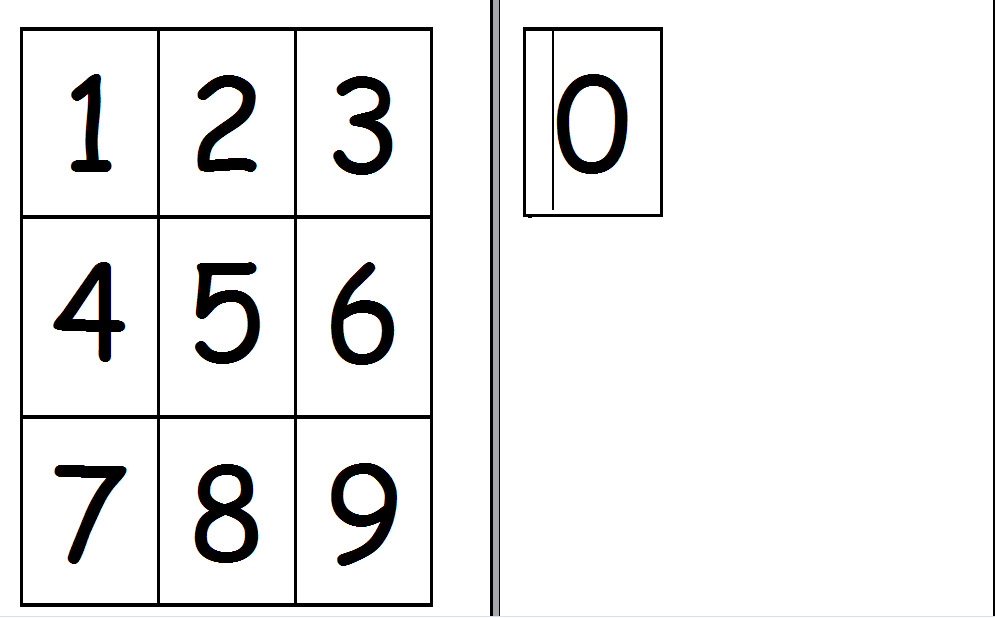
At the beginning of the school year, there are many procedures, routines, rituals, and rules that need to be taught. If you are planning on teaching cooperative group procedures and norms, these numeral cards may be used with many different types of games and activities such as Close to 20, Close to 100, Close to 1000, Place Value Games and the like. I have searched for numeral cards on the internet before and had a difficult time finding some, so I had to make my own. You are welcome to download and use these. Just click the link.